
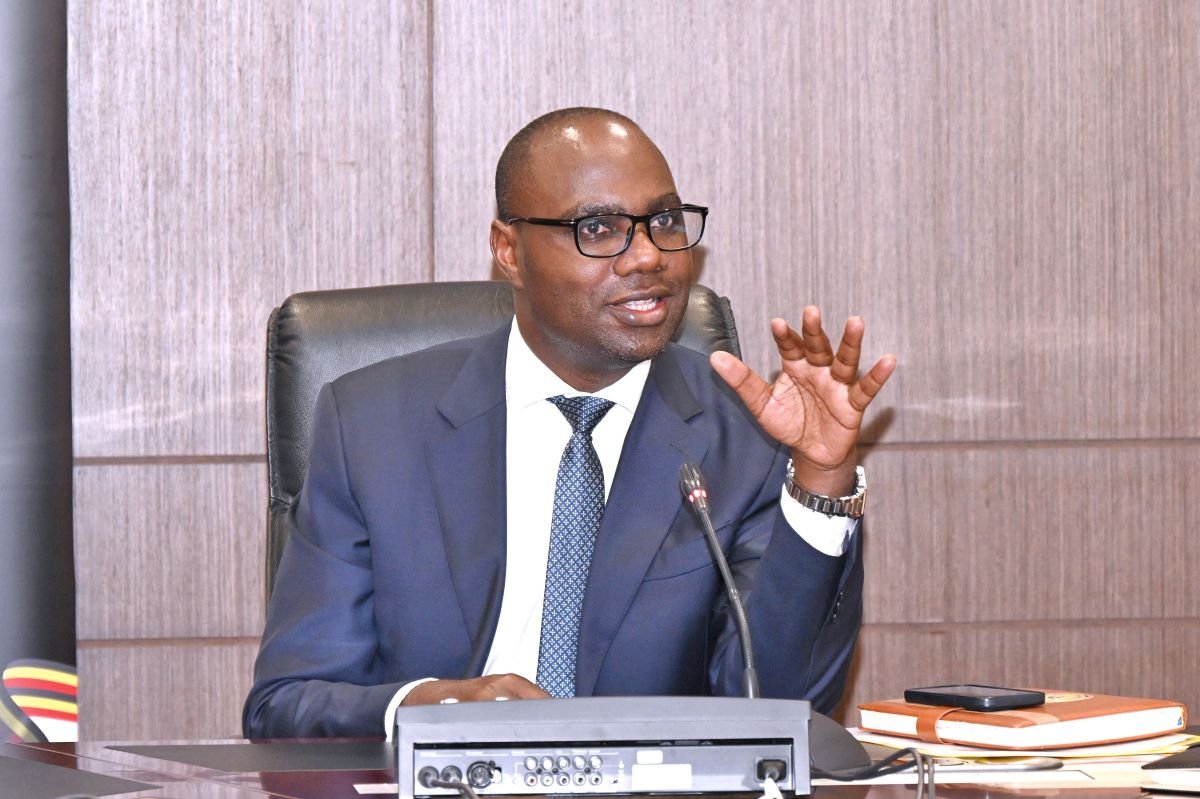
Finance Minister Henry Musasizi has challenged the Uganda National Oil Company (UNOC) to develop alternative and sustainable financing mechanisms to reduce its dependence on direct government budget support as Uganda moves closer to first oil.
Musasizi, together with State Minister for Planning Amos Lugoloobi and other officials, tasked the UNOC Board to explore innovative financing options capable of strengthening the company’s financial position and supporting its expanding role in Uganda’s petroleum sector.
The directive comes at a critical stage for Uganda’s oil industry, with major projects progressing towards production and UNOC taking on an increasingly central role in petroleum supply, infrastructure development and commercialisation.
Musasizi commended UNOC for keeping the country supplied with petroleum products despite geopolitical tensions and conflicts affecting major oil-producing regions.
Uganda has continued to enjoy relatively stable fuel availability and prices, he said, although he questioned the significant differences in pump prices across the country.
The Minister pointed to price variations between Kabale, Masaka, Mbarara and Kampala, raising questions about the factors driving disparities in the cost of fuel despite UNOC’s growing role in petroleum supply.
UNOC faces $72m cash-call bill
The financing challenge comes as Uganda approaches the most critical phase of its oil development.
UNOC reported that by the end of June 2026, construction of the East African Crude Oil Pipeline (EACOP) had reached 89.4%, while the Kingfisher Development Project stood at 79.36% and the Tilenga project at 74.2%.
With the projects advancing towards first oil, UNOC expects to face cash-call obligations of approximately US$72 million, increasing the pressure on the company to secure reliable sources of capital.
The scale of the financial requirements means that continued reliance on government appropriations could constrain UNOC’s ability to execute its expanding mandate.
The company is therefore pushing for a model in which its commercial activities increasingly generate the resources required to finance its operations and investments.
Sole importer expands business
UNOC has already expanded its position in Uganda’s petroleum market through its sole-importation mandate.
The company reported that petroleum volumes handled under sole importation increased by 39%, with UNOC now supplying 36 oil marketing companies.
Its gross margins also increased substantially, rising from Shs387 billion to Shs540 billion in the 2025/26 financial year.
UNOC has argued that these commercial activities provide a foundation for a more sustainable financing model.
The company estimates that its sole-importation business generates approximately US$3 million every month in administrative charges, potentially giving it a recurring revenue stream that could be reinvested into its operations and strategic projects.
$2bn Vitol financing facility
UNOC is also leveraging external financing to fund its expanding operations.
Under its US$2 billion financing facility with Vitol Bahrain, US$150 million had been disbursed, with Shs536 billion transferred to the Ministry of Finance.
The financing arrangement is part of the broader strategy to mobilise capital outside the traditional government budget framework as UNOC positions itself to become a commercially sustainable national oil company.
However, UNOC maintains that government capitalisation remains important, particularly as the company takes on capital-intensive infrastructure and its obligations as Uganda’s national oil company increase.
Massive infrastructure programme
Beyond petroleum trading, UNOC is developing a network of infrastructure intended to strengthen Uganda’s position in the regional petroleum supply chain.
This includes the 320-million-litre Kampala Storage Terminal and a 110-million-litre storage terminal in Mombasa, which is expected to provide additional strategic capacity for Uganda’s petroleum imports.
UNOC is also involved in plans for a 60,000-barrel-per-day oil refinery, alongside infrastructure development at the Kabalega Industrial Park.
For Phase One of the industrial park infrastructure, UNOC reported that Shs37.96 billion had been secured.
The projects are expected to increase Uganda’s ability to store, process and distribute petroleum products while creating new commercial opportunities around the country’s emerging oil and gas industry.
First oil raises stakes for UNOC
The push for financial independence reflects the changing role UNOC is expected to play as Uganda transitions from an oil-producing hopeful to an oil-producing country.
The company will be central to Uganda’s participation in the petroleum value chain, meaning its financial strength will determine how effectively it can participate in upstream projects, petroleum trading, infrastructure development and future investments.
The Government’s challenge is therefore to strike a balance between providing UNOC with enough capital to execute its strategic mandate while ensuring that the company develops commercially sustainable revenue streams rather than becoming permanently dependent on taxpayers.
UNOC’s proposed self-financing model is aimed at addressing that challenge.
However, the company says government support remains critical, particularly during the current investment-heavy phase, arguing that continued capitalisation will help unlock its potential to generate greater value from Uganda’s petroleum resources.
With EACOP, Tilenga and Kingfisher all approaching completion, the financial sustainability of UNOC is increasingly becoming a strategic national issue.
The government’s message to the company is clear: as Uganda approaches first oil, UNOC must not only become the vehicle through which the country participates in the petroleum industry—it must also build the financial muscle to sustain that role without placing an ever-growing burden on the national budget.