
The National Agricultural Research Organisation (NARO) is stepping up efforts to expand cassava production in drought-prone Karamoja, targeting improved food security and household incomes as climate change continues to disrupt farming in the region.
Through the Uganda Climate-Smart Agricultural Transformation Project (UCSATP), NARO has established a 200-acre cassava multiplication and demonstration facility at Nabuin Zonal Agricultural Research and Development Institute (ZARDI) in Napak District.
The facility is designed to increase farmers’ access to quality cassava planting materials while demonstrating modern production technologies suited to Karamoja’s harsh climatic conditions.
Dr Walter Odongo, Director of Research at Nabuin ZARDI, said the intervention is intended to address two major challenges facing farmers—limited access to quality planting materials and inadequate knowledge of improved cassava production.
“The intention here is about two-fold: one, to increase access to quality planting material, but also to demonstrate cassava production technology to the farmers,” Odongo said.
Cassava seen as drought buffer
NARO researchers believe cassava could become an important weapon against hunger in Karamoja because of its ability to withstand dry conditions and remain in the ground for long periods.
Odongo said cassava’s resilience makes it particularly suitable for a region increasingly exposed to prolonged dry spells and unpredictable rainfall.
“Cassava has proven to be a very resilient crop for the farmers,” he said, noting that varieties such as NAROCAS 1 have demonstrated good adaptation to the region.
The project is working with about 200 farmer groups, with the 200-acre multiplication block expected to provide planting materials for approximately 6,000 farmers.
Dr Damalie Akwango, the NARO coordinator for UCSATP, described the initiative as an important step towards the project’s objective of expanding access to improved agricultural planting materials.
“This is a good move towards the achievement of what is planned in the project,” Akwango said.
Three improved varieties promoted
NARO is currently promoting three cassava varieties at the Nabuin demonstration site: NASE 14, NASE 19 and NAROCAS 1.
According to Senior Research Officer Dr Ijara Anthony Raphael, the varieties were selected because of characteristics including high yields, adaptability and relatively early maturity.
“NASE 14 is easily adaptable to the soil and it is high yielding and quick maturing. NASE 19 equally has high-yielding traits,” Ijara said.
NAROCAS 1 is also being promoted because of its high yield potential and performance in different parts of Uganda.
Researchers are particularly keen to change the traditional perception of cassava in Karamoja, where the crop is often viewed as something that grows without deliberate cultivation.
“In Karamoja, cassava is perceived as a wild crop that grows on its own, so we are trying to stimulate uptake of cassava,” Ijara said.
The Nabuin facility is consequently being used as both a multiplication centre and practical training ground where farmers can see improved planting and management practices.
Crop can stay underground for more than two years
One of cassava’s biggest advantages for Karamoja is its harvesting flexibility.
Unlike crops that have to be harvested within a relatively short window, cassava can remain underground for an extended period and be harvested gradually whenever a household needs food.
“Cassava can ensure food availability throughout the year because it can be harvested piecemeal and is always available when needed,” Ijara said.
He added that cassava can remain in the soil for more than two years, giving households an additional food reserve during periods when other crops have failed or food stocks have run low.
For communities regularly affected by drought, the characteristic could make cassava an important component of household resilience.
Project creates jobs for women and youth
The cassava project is also generating temporary employment for communities around the demonstration site.
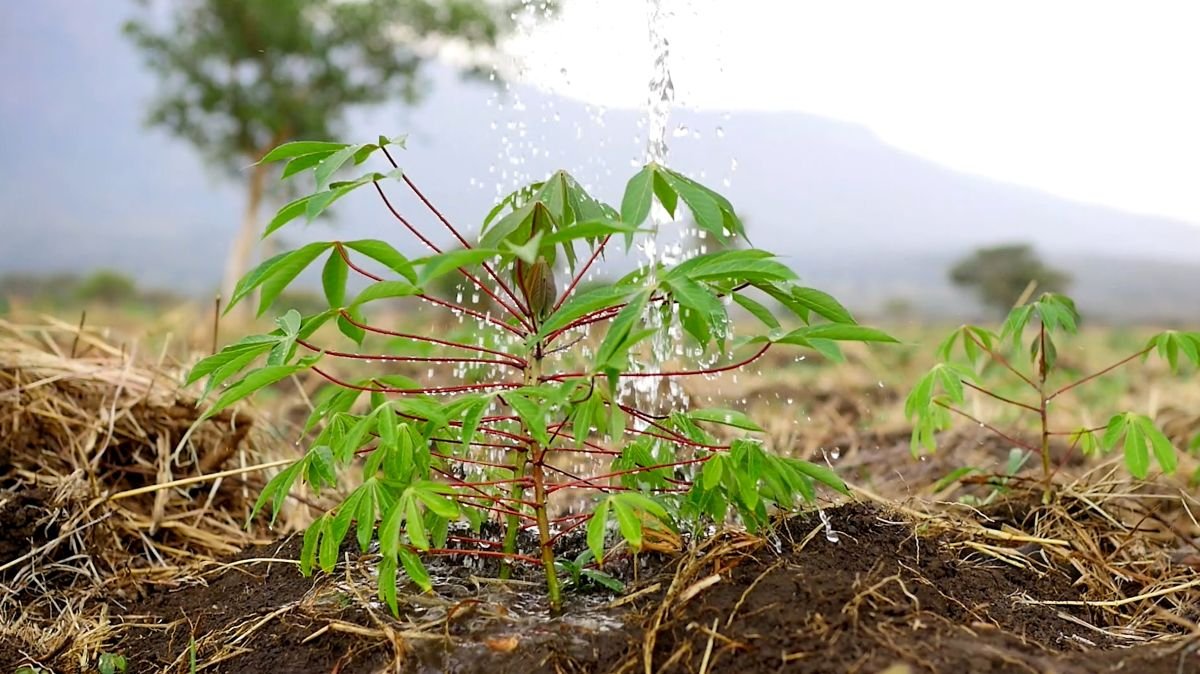
Ijara said approximately 50 workers are engaged daily in activities including planting, weeding and watering.
Many of the workers are women and youth, who earn about Shs7,000 per day.
“Like now it is dry, you can see they are providing water physically and they earn a living from doing that,” he said.
The site is additionally being used to provide practical training to students pursuing certificate, diploma, degree and postgraduate agricultural programmes.
Ijara said the facility would help transfer cassava production skills to a new generation of agricultural professionals and farmers.
Farmers see food and income opportunity
For farmers involved in the programme, the improved cassava varieties offer an opportunity to address food shortages while creating an additional source of household income.
Lugel Patrick, a host farmer in Napak, said farmers who have undergone NARO training are increasingly embracing the improved varieties.
“These cassava varieties are very good. Farmers are very happy about them,” Lugel said.
He urged more farmers across Karamoja to adopt cassava as part of efforts to combat hunger.
“My call to the farmers in Karamoja is that they should continue planting cassava to fight hunger. We want cassava as a staple food,” he said.
Lugel said cassava can also be combined with sorghum, another important food crop in the region.
After harvesting, farmers can dry the cassava and take it for milling before mixing the flour with sorghum to make a meal.
But beyond food security, Lugel said cassava can provide an income stream for households.
Money earned from selling cassava can help families meet expenses such as school fees and purchase livestock.
NARO eyes cassava “nuclear farm” for Karamoja
NARO is positioning the 200-acre facility as a strategic “nuclear farm” from which planting materials, technologies and skills can spread to farmers across Karamoja.
The broader objective is to shift cassava from being viewed as a largely neglected or self-growing crop into a deliberately cultivated food and commercial crop.
With climate variability increasingly threatening conventional agricultural production in Karamoja, NARO and its partners are betting on cassava and other climate-smart crops to strengthen food supplies, create income opportunities and help households withstand prolonged drought.
If successfully scaled up, the initiative could make cassava an important part of Karamoja’s strategy for building long-term resilience against climate-related food insecurity.