

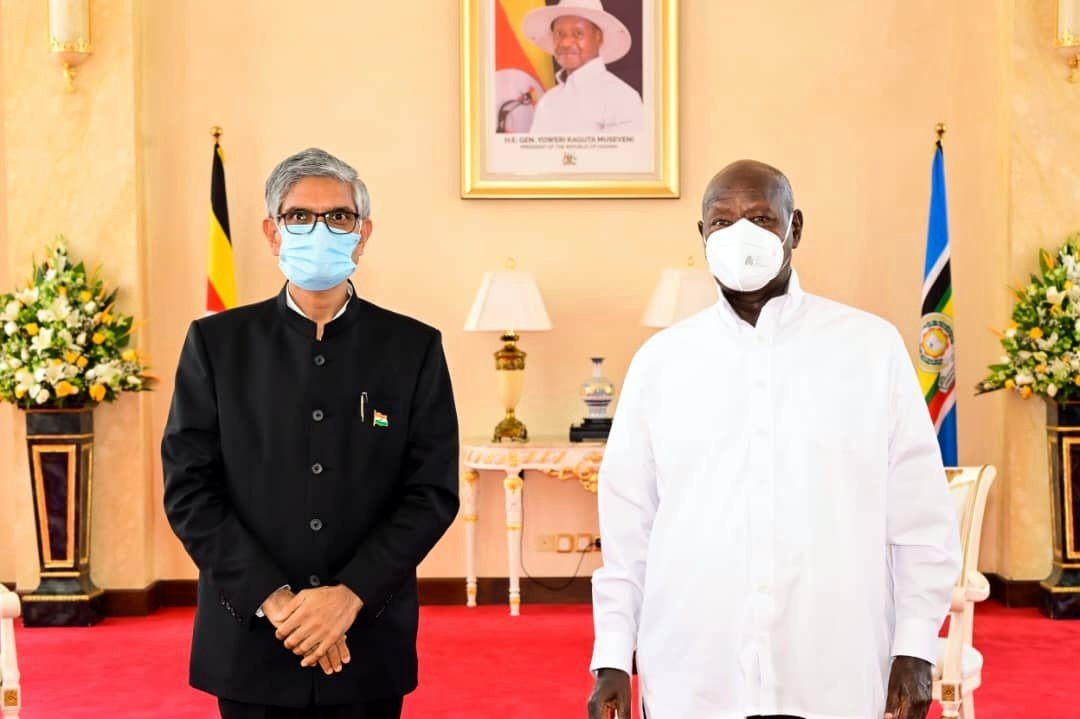
President Yoweri Kaguta Museveni has held talks with India’s outgoing High Commissioner to Uganda, Upender Singh Rawat, focusing on expanding bilateral cooperation in science, technology and digital transformation.
Museveni received Rawat at State House Entebbe on Monday as the Indian diplomat concludes his tour of duty in Uganda.
According to Museveni, the discussions centred on strengthening cooperation in areas including the National Payment Switch and technology transfer, signalling continued efforts to deepen Uganda-India collaboration in the digital economy.
The President also highlighted the progress of the National Forensic Sciences University (NFSU) campus in Jinja, which was established through cooperation between Uganda and India.
“We discussed strengthening Uganda-India cooperation in science, technology and digital transformation, including the National Payment Switch and technology transfer,” Museveni said.
Jinja forensic university becomes key area of cooperation
Museveni said he was pleased with the progress made at the NFSU campus, describing it as an important outcome of Uganda-India cooperation.
The Jinja campus was inaugurated in April 2023 as NFSU’s first overseas campus and India’s first overseas campus of a public academic institution. It was established to build capacity in forensic science, cybersecurity, digital forensics, police science and related fields.
The institution currently operates from Gaddafi Barracks in Jinja, while the Ugandan government has earmarked 130 acres near Jinja Airport for permanent infrastructure. Its programmes include forensic science, cyber security and digital forensics.
The partnership has also expanded into practical forensic capabilities. In September 2026, the Jinja campus hosted a rapid-DNA workshop, with Uganda unveiling capacity for rapid DNA testing aimed at supporting criminal investigations and disaster victim identification.
The development has reinforced the strategic importance of the Jinja institution beyond academic training, with the campus seeking to provide specialised skills to Ugandan and other African security and justice-sector personnel.
Digital transformation on the agenda
The National Payment Switch was another major issue discussed by Museveni and Rawat.
The President’s remarks place digital financial infrastructure alongside technology transfer and scientific cooperation as areas where Uganda wants to deepen its engagement with India.
The talks come as Uganda continues to pursue greater use of digital technologies across government and the economy, while seeking to strengthen domestic technological capacity.
Museveni thanked Rawat for his contribution to Uganda-India relations and wished him well as he completes his diplomatic assignment.
The meeting therefore underscored three broad areas of the bilateral relationship: digital transformation and payment infrastructure, technology transfer, and specialised scientific training through the NFSU campus in Jinja.
India and Uganda have maintained cooperation in education, security, technology and other sectors, with the Jinja NFSU campus emerging as one of the most visible recent institutional partnerships between the two countries.