

Makerere University spent a staggering Shs128.35 billion on 22 planned outputs during the 2024/25 financial year, but auditors were unable to establish whether the money actually delivered the intended results.
The damning finding is contained in the university’s FY2024/25 audit, which exposes major weaknesses in how Makerere planned, measured and accounted for the results of its spending.
According to the audit, 22 outputs involving expenditure of Shs128.354 billion could not be assessed because the university had not provided adequate performance targets and indicators against which implementation could be measured.
The auditors said the absence of clearly defined targets made it impossible to determine whether the university had achieved what it had planned to deliver despite the money being spent.
The problem was compounded by the failure to break down expenditure by individual activities under each output.
This means that while financial records could show that billions of shillings had been spent, the auditors could not reliably establish what was delivered for the money.
Billions spent, results unclear
The audit examined non-payroll outputs with expenditure worth Shs148.362 billion.
Of the 32 outputs assessed:
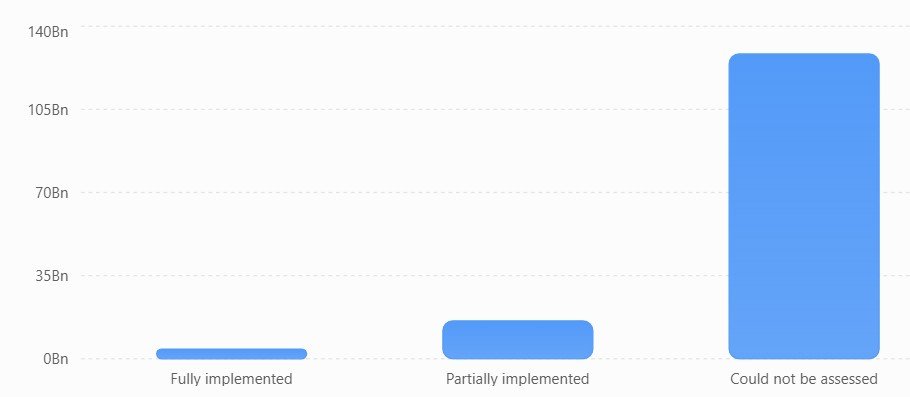
- 4 outputs, worth Shs4.058 billion, were fully implemented.
- 6 outputs, worth Shs15.950 billion, were only partially implemented.
- 22 outputs, involving Shs128.354 billion, could not be assessed.
- No output was classified as completely unimplemented.
The figures mean that only a small portion of the university’s output spending could be conclusively linked to full implementation.
Source: Makerere University FY2024/25 audit update supplied.
The auditors specifically warned that the lack of performance targets and indicators undermined their ability to assess whether the university had achieved its intended results.
For instance, simply recording expenditure on library books does not demonstrate whether the university actually delivered the planned books.
A proper performance target would specify the quantity or other measurable result expected, allowing auditors to compare the planned target against what was actually delivered.
Without such indicators, expenditure becomes easier to verify than performance.
Shs370.6Bn budget, 96% spent
The audit also shows that Makerere had Shs370.647 billion warranted across recurrent and capital development expenditure during the period.
The university spent Shs355.793 billion, representing 96 per cent of the warranted funds.
Recurrent wage expenditure stood at Shs221.607 billion, of which Shs207.431 billion was spent, representing 94 per cent.
For recurrent non-wage expenditure, Shs135.205 billion was warranted and Shs134.538 billion was spent, representing 100 per cent.
Capital development had Shs13.835 billion warranted, with Shs13.824 billion spent, also representing 100 per cent.
Yet the audit makes clear that high absorption of funds did not automatically translate into demonstrable delivery of outputs.
Auditors raise accountability concerns
The report further notes that the absence of cost breakdowns for individual activities within outputs limited effective performance assessment.
In other words, even where an output had funding attached to it, auditors lacked sufficient detail to determine how much was spent on specific activities and whether each activity achieved its intended target.
The audit consequently warns that failure to fully implement planned outputs denies timely delivery of services to intended beneficiaries.
The findings put the spotlight not simply on how much Makerere spent, but on the more fundamental question of what students, staff and other intended beneficiaries received in return for the money.
With Shs128.354 billion tied to outputs that auditors could not assess, the report raises serious questions about performance planning, monitoring and accountability at one of Uganda’s most prominent public universities.