

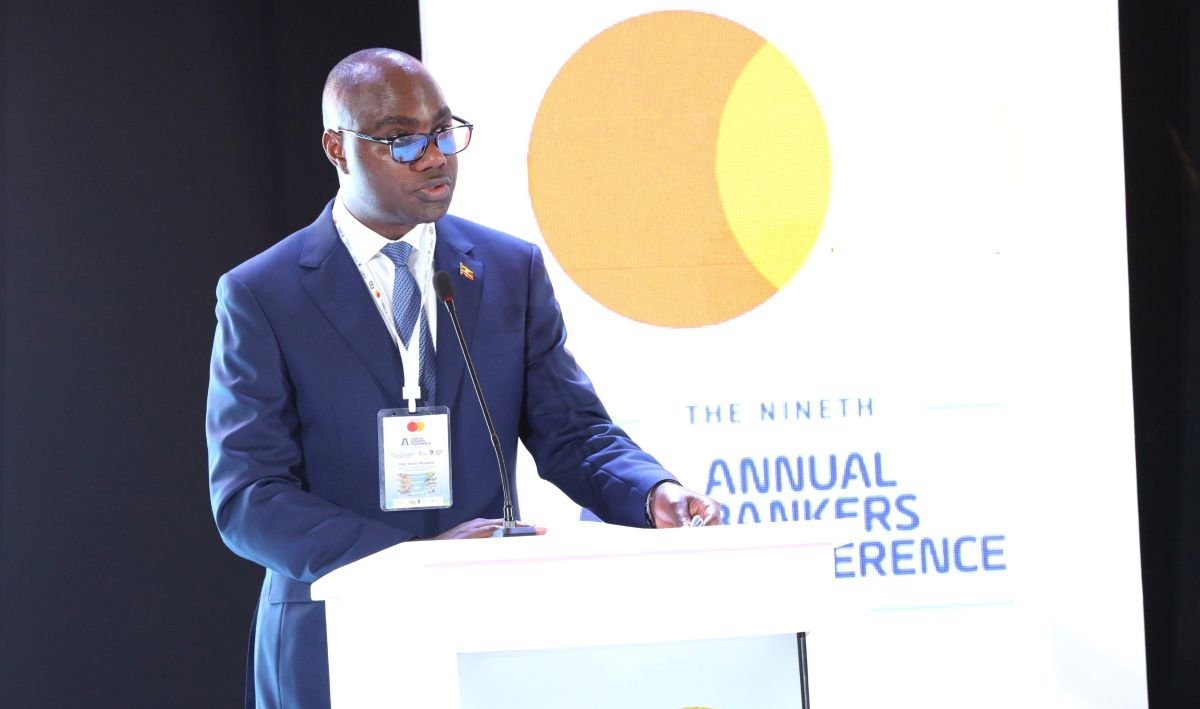
Finance Minister Henry Musasizi has challenged Uganda’s banking sector to slash lending rates and redirect more credit towards productive sectors as the Government pushes an ambitious plan to expand the economy tenfold by 2040.
Musasizi said Uganda’s target of growing the economy from about US$50 billion in the 2025/26 financial year to US$500 billion by 2040 will require affordable, patient and significantly larger pools of financing from banks and other financial institutions.
He made the remarks while speaking at the 9th Annual Bankers Conference at Marriott Hotel, Nsambya, Kampala, where he positioned the financial sector as a central player in delivering the Government’s Tenfold Growth Agenda.
“Government cannot deliver Uganda’s transformation alone. We need you and indeed, the banking and financial sector is central to the tenfold growth strategy,” Musasizi said.
High cost of credit threatens investment
The Minister singled out the cost of borrowing as one of the major constraints to private-sector investment, noting that average commercial lending rates currently range between 18% and 20%.
He urged banks to find ways of reducing the risk premiums embedded in loan pricing while expanding access to long-term credit for businesses seeking to invest and expand.
Musasizi called on financial institutions to strengthen credit assessment systems, make better use of available data within the law and expand risk-sharing and guarantee mechanisms.
The measures, he said, could help banks better assess borrowers and reduce the risks that ultimately translate into higher borrowing costs.
The Government’s financing ambitions are substantial. Musasizi said private-sector credit must rise from about Shs28 trillion currently to Shs490 trillion by 2040, while mobilisation through capital markets should increase from approximately Shs1.5 trillion to Shs440 trillion.
Banks told to move beyond trade
Musasizi also challenged banks to change the composition of their lending portfolios, arguing that excessive concentration of credit in trade will not deliver the structural transformation Uganda is targeting.
He urged lenders to increase financing to the ATMS priority sectors — Agro-industrialisation, Tourism, Minerals including Oil and Gas, and Science, Technology and Innovation.
The sectors are expected to play a major role in expanding production, exports, industrialisation, tourism receipts, mineral development and technology-driven enterprises.
The Minister further urged banks to work closely with the Capital Markets Authority to unlock longer-term financing through instruments such as infrastructure bonds, project bonds, green bonds and equity financing.
Such instruments, he said, are necessary because some investments require financing horizons that conventional bank loans may not adequately provide.
Eight million farmers targeted
Musasizi also placed financial inclusion at the centre of Uganda’s economic transformation agenda, particularly for farmers being targeted for commercialisation under the Parish Development Model.
He called for financial institutions to scale up services that allow farmers to save, borrow, insure, receive payments and invest.
The focus on farmers reflects the Government’s broader push to shift households from subsistence production into commercial agriculture and integrate them into formal financial systems.
Bankers demand broader financing mix
Uganda Bankers Association Chairperson and Housing Finance Bank Chief Executive Officer Michael Mugabi reaffirmed the banking industry’s commitment to the US$500 billion economic ambition but cautioned that bank lending alone would not generate the scale of financing required.
Mugabi called for a broader financing ecosystem involving equity finance, diaspora capital, blended financing, impact funds, sustainability finance and risk-mitigation instruments.
“Our mission without execution is merely an aspiration,” Mugabi said.
He urged stakeholders to move beyond broad commitments and identify specific financing bottlenecks before developing practical solutions capable of mobilising capital at scale.
Atingi-Ego warns against reckless credit expansion
Bank of Uganda Governor Michael Atingi-Ego emphasised that financial stability must remain the foundation for increased lending and investment.
He highlighted Uganda’s 6.4% real GDP growth and 3.3% inflation over the 12 months to July, alongside a decline in the banking sector’s non-performing loans to 2.67%.
However, Atingi-Ego cautioned banks to ensure that credit expansion is supported by adequate deposits, long-term funding and capital.
He also called for pension funds, insurance companies, development finance institutions and capital markets to play a greater role in financing Uganda’s long-term development.
The Governor challenged financial institutions to submit measurable ATMS financing strategies and translate conference commitments into funded and executable projects.
He said Uganda’s transformation would ultimately depend on coordinated capital mobilisation for farmers, factories, hotels, mines and innovators.
Government promises policy support
Musasizi said Government would continue maintaining macroeconomic stability and implementing financial-sector reforms while working to expand the capitalisation of the Uganda Development Bank.
The Government’s message to the financial sector is therefore increasingly centred on scale: cheaper credit, longer repayment horizons, deeper capital markets and a greater flow of financing into sectors capable of expanding Uganda’s productive capacity.
For the Tenfold Growth Agenda to move from a headline target to measurable economic expansion, however, the commitments made by Government, banks, regulators and other investors will have to translate into actual capital reaching businesses and productive enterprises.