

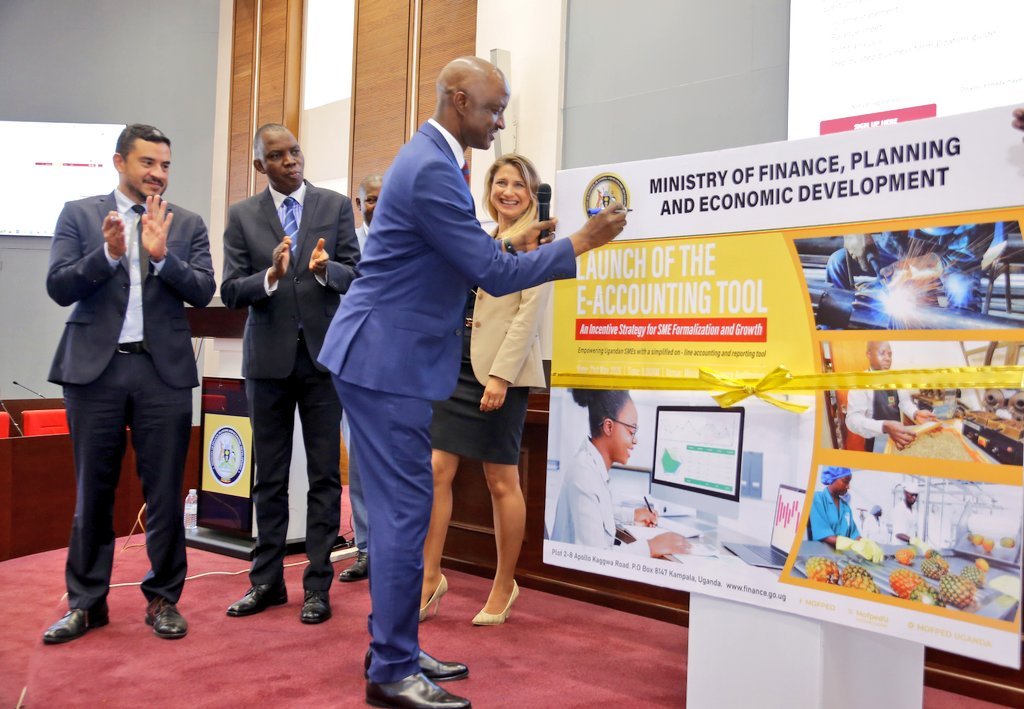
The Permanent Secretary and Secretary to the Treasury at the Ministry of Finance, Planning and Economic Development, Ramathan Ggoobi, has launched a simplified E-Accounting tool aimed at accelerating the formalisation and growth of Uganda’s small informal enterprises through digital financial management.
Dr. Ggoobi, who is also serving as Acting Minister of Finance, said the new digital platform is part of a broader transformation agenda intended to transition small informal enterprises into compliant and high-growth medium-sized businesses.
The tool was developed by United Nations Conference on Trade and Development under the Informality Management for Compliance and Revenue Mobilisation (IMCORE) Programme as part of ongoing technical assistance to Uganda.
Speaking during the launch, Dr. Ggoobi described small and medium enterprises (SMEs) as the backbone of Uganda’s economy, noting that they play a critical role in employment creation and household income generation.
According to the Ministry of Finance, Uganda’s informal sector comprises more than 1.8 million micro, small and medium enterprises, the majority of which are operated by women, youth and refugees. The sector contributes 54.5 percent of the country’s Gross Domestic Product and accounts for 92 percent of total employment.
However, Dr. Ggoobi said many businesses remain trapped in informality due to weak financial management systems and limited record-keeping practices.
“Without proper records, businesses cannot assess performance, financial institutions cannot trust them and tax compliance remains inconsistent,” he said.
He added that improving financial accountability among SMEs is essential to achieving Uganda’s Ten-Fold Growth Strategy, which seeks to expand the economy significantly through productivity, industrialisation and increased domestic revenue mobilisation.
The PSST further described the E-Accounting platform as a “single-window solution” that combines legal and fiscal formalisation, enabling businesses to maintain financial records while also improving compliance with tax and regulatory requirements.
Officials said the digital tool is designed to simplify bookkeeping for small enterprises by offering an affordable and accessible platform for financial reporting and cash management.
During the official handover of the platform to the Ministry of Finance following the pilot phase, Elena Botvina, an Economic Affairs Officer in the Division on Investment and Enterprise at UNCTAD, said the tool would support small businesses in improving operational efficiency and financial transparency.
She noted that the platform is cost-effective, easy to use and capable of enhancing cash flow management, expense tracking and revenue growth for small enterprises.
The pilot testing phase involved 30 small informal enterprises operating within Kampala. According to officials, more than 490 SMEs have already tested the system and expressed positive feedback on its usability, while 241 enterprises have formally registered and created accounts on the platform.
Government officials believe the initiative could play a significant role in expanding Uganda’s tax base, improving access to financing for SMEs and strengthening financial inclusion across the informal sector.
The launch comes at a time when Uganda is intensifying efforts to digitise public and private sector operations as part of wider economic modernisation and revenue mobilisation reforms.