

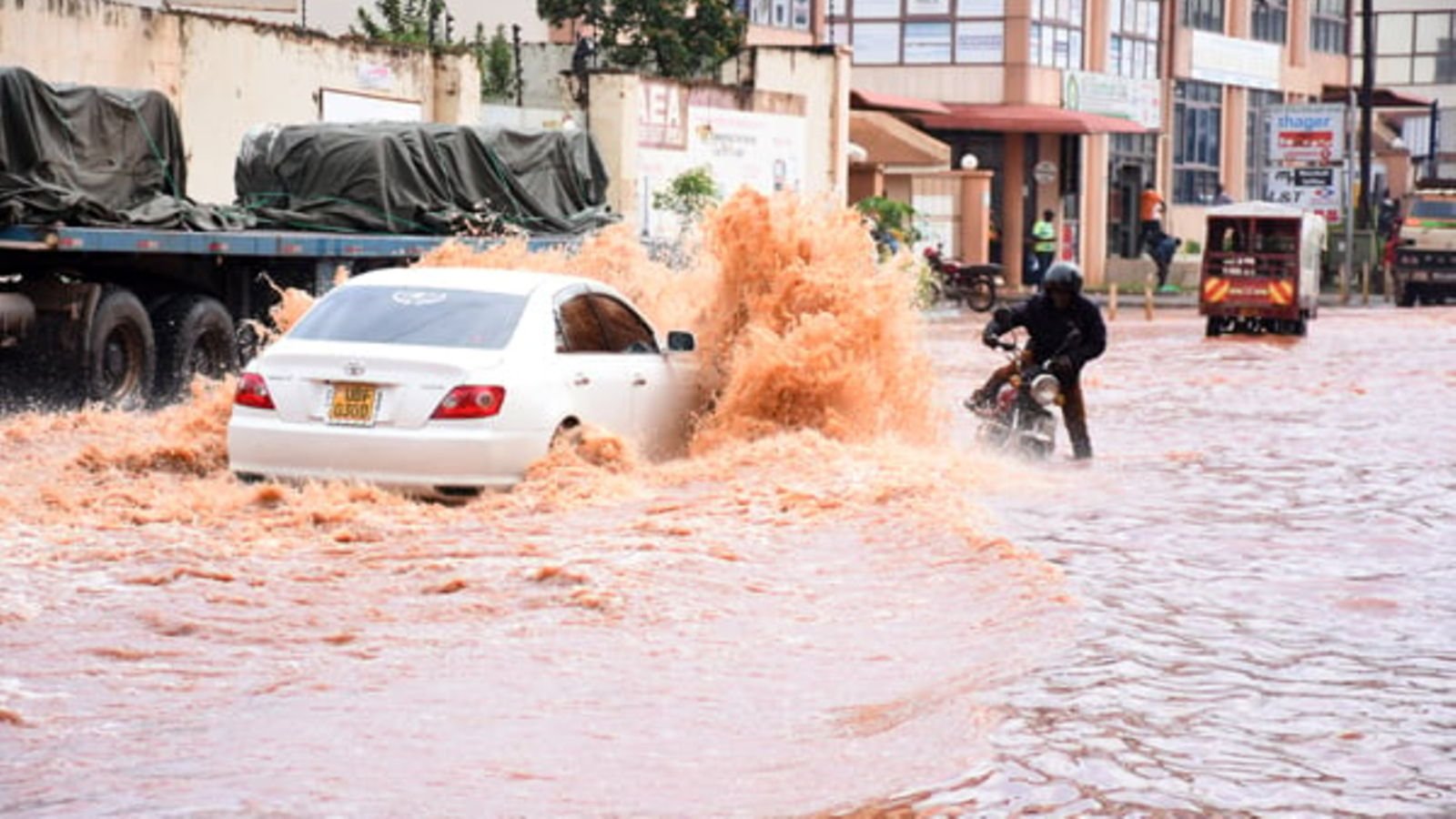
Chief of Defence Forces, Gen Muhoozi Kainerugaba, has issued a fiery and uncompromising statement accusing past city administrators and contractors of sabotaging Kampala’s drainage systems and contributing to the capital’s worsening flood crisis.
In a strongly worded post shared on social media, Gen Muhoozi blamed decades of alleged corruption and poor planning for the persistent flooding that continues to paralyse Kampala during heavy rains, warning that what he termed “stealing from Kampala” would no longer be tolerated.
His remarks come amid renewed public frustration over recurring floods, destroyed roads, blocked drainage channels, and the continued encroachment on wetlands that naturally regulate water flow in the city.
“40 YEARS OF FAILURE”
Gen Muhoozi opened his statement with a blistering critique of past urban management, arguing that corruption and negligence have crippled the city’s infrastructure for decades.
“You allow thieves to never build drainage systems in Kampala for 40 years, then you allow them to build in God’s natural drainage system… the wetlands! Why wouldn’t Kampala flood?” he wrote.
The comments reflect long-standing concerns raised by urban planners and environmental experts who have repeatedly warned that unregulated construction, poor drainage design, and wetland destruction have left Kampala increasingly vulnerable to flooding.
Over the years, several parts of the city — including Ndeeba, Bwaise, Kalerwe, and parts of Nakawa — have become notorious flood hotspots, with residents frequently losing property during rainy seasons.
WETLAND ENCROACHMENT UNDER FIRE
A key focus of Gen Muhoozi’s statement was the destruction of wetlands, which serve as natural water absorption zones for the city’s drainage system.
Environmental experts have long cautioned that the degradation of wetlands around Kampala has significantly reduced the city’s ability to manage stormwater. Large sections of Lubigi, Nakivubo, and other wetland systems have been converted into industrial zones, residential estates, and commercial developments.
While government agencies have in recent years launched eviction drives and restoration projects, enforcement has often been inconsistent, with accusations of powerful interests benefiting from illegal encroachment.
Muhoozi’s remarks suggest a more aggressive stance may be coming from security-linked leadership structures.
“STEALING FROM KAMPALA IS STEALING FROM GOD”
In the most striking portion of his message, Gen Muhoozi escalated his rhetoric by equating corruption in city infrastructure with a moral and almost spiritual offence.
“From now on stealing from Kampala will be equivalent to stealing from Jesus Christ! They will pay,” he declared.
The statement has already sparked intense debate across political and public circles, with supporters interpreting it as a tough anti-corruption stance, while critics warn that such rhetoric blurs the line between governance, religion, and enforcement messaging.
Religious imagery in political communication is not new in Uganda, but analysts say the framing raises questions about how anti-corruption enforcement may be pursued going forward.
PUBLIC REACTION AND POLITICAL IMPLICATIONS
Within minutes of the post, reactions poured in across social media platforms, with some Kampala residents welcoming the tough talk, saying it reflects their daily frustrations with flooding and broken infrastructure.
Others, however, questioned whether the problem lies solely with “thieves” or whether it reflects deeper systemic failures in urban planning, procurement, and accountability structures.
Urban governance experts note that Kampala’s drainage challenges are complex and tied to rapid urbanisation, population growth, underfunded infrastructure maintenance, and inconsistent enforcement of environmental regulations.
A CITY AT A CROSSROADS
Kampala continues to face increasing pressure from climate variability, unplanned settlements, and infrastructure strain. Flooding remains one of the city’s most visible and disruptive challenges, often bringing traffic to a standstill and damaging businesses and homes.
Gen Muhoozi’s remarks add a new political dimension to an already sensitive issue, signalling potential shifts in how infrastructure corruption and environmental degradation may be addressed.
However, whether the rhetoric translates into institutional reform or enforcement action remains to be seen.
For now, his message has landed with force: Kampala’s flooding crisis is no longer being framed as just an engineering failure — but as a moral battle against corruption embedded in the city’s development history.