

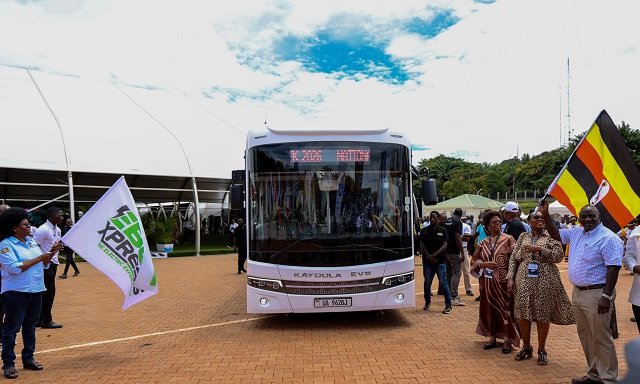
Uganda has officially launched its first electric commuter bus service in Kampala, signaling the beginning of a major national transition toward cleaner, modern urban transport systems.
The new service was unveiled by Works and Transport Minister Edward Katumba Wamala and marks the first active route in a larger government strategy aimed at introducing electric public transport across 14 cities by 2030.
The pilot route operates between Ntinda and City Square through Kampala Road and forms part of a wider five-route transport network planned for the Greater Kampala Metropolitan Area.
The buses are operated by E-Bus Xpress, a subsidiary of Kiira Motors Corporation. The service begins with eight electric buses and is expected to maintain departures every 15 minutes. Commuters will also use a fully cashless payment system, reflecting Uganda’s growing shift toward digital transport solutions.
The Kampala launch comes months after a successful pilot phase in Jinja in late 2024. Uganda now joins countries such as Kenya, Rwanda and Ethiopia, which are also investing heavily in electric mobility and sustainable public transport.
Speaking at the launch, Katumba Wamala said the initiative would help Uganda reduce dependence on imported fuel while protecting commuters from rising global fuel prices by relying more on locally generated electricity.
Government plans indicate that by June 2030, Uganda hopes to deploy 1,500 electric buses supported by 260 fast-charging stations across major urban centres. Officials say the charging infrastructure will be essential in expanding operations beyond Kampala.
At the core of the project are the locally manufactured Kayoola electric buses produced by Kiira Motors. The government views the vehicles as a major part of Uganda’s industrialisation drive and efforts to strengthen energy independence.
Authorities also believe the programme will create employment opportunities in areas such as vehicle maintenance, charging infrastructure management, mobile payment systems and park-and-ride services. A franchise-based operating model is additionally expected to help integrate informal transport operators into the formal public transport sector.
The rollout aligns with Uganda’s National Development Plan IV, which identifies urban infrastructure and transport efficiency as major contributors to economic growth.
With Kampala continuing to battle traffic congestion and rapid urban population growth, officials see the electric bus system as a long-term solution for improving mobility while reducing carbon emissions.
As operations officially begin in Kampala, the focus will now shift to whether Uganda can successfully scale the electric transport system into a commercially sustainable nationwide network.