
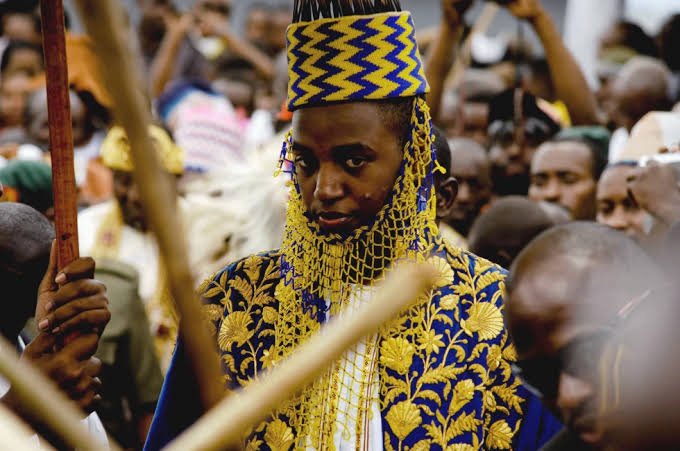
For most people, childhood is a time to grow into who you will become. For Oyo Nyimba Kabamba Iguru Rukidi IV, it was the opposite, he was handed a crown before he had even learned what a kingdom truly was, and spent the rest of his life growing into a role the world had already assigned him. When he died on 27 August 2026 at the age of 34, he had been the Omukama of Tooro for almost every day of his life, and had carried the unusual distinction of becoming, and remaining, the world’s youngest reigning monarch.
Born into a Kingdom, Orphaned into a Throne
Oyo was born on 16 April 1992, the second child of King Patrick David Matthew Kaboyo Rwamuhokya Olimi III and Queen Best Kemigisa Akiiki. His father, the 12th Omukama of Tooro, died suddenly of a heart attack on 26 August 1995 at the royal palace in Fort Portal. He was only 49. In an instant, his three-year-old son became heir to a throne that had existed for more than two centuries.
Sixteen days later, on 12 September 1995, the toddler prince ascended to the throne, undergoing the traditional rites that transformed him into Omukama Oyo Nyimba Kabamba Iguru Rukidi IV. Accounts from the day describe a child too young to grasp the ceremony’s weight, he reportedly toyed with objects during the proceedings, wandered from the throne to climb into his mother’s lap, and pulled off the heavy lion-skin crown partway through. It was a moment equal parts solemn and utterly childlike, and it made him, at three years old, the youngest reigning monarch on the planet, a distinction later recognised by the Guinness World Records.
Because a toddler obviously could not run a kingdom, a group of regents stepped in to guide Tooro’s affairs until Oyo came of age. Chief among them were his mother, Queen Best Kemigisa; Princess Elizabeth Bagaya, a former Tooro princess and one of Uganda’s most storied stateswomen; and Uganda’s President Yoweri Museveni, alongside other senior royals. It was an arrangement that let Oyo have something resembling a childhood while the throne was kept warm for him.
An Education Built Around a Crown
Tooro Kingdom has described Oyo’s schooling as deliberately varied, starting with home tutoring in his earliest years, followed by carefully chosen formal institutions that could accommodate both his education and his position. He spent time in London as a young child, attending preschool there, before returning to Uganda to enrol at Aga Khan Primary School in Kampala, where he studied from 1999 to 2004. He went on to Kabira International School from 2005 to 2009, and then crossed back to the United Kingdom for his university education, earning a bachelor’s degree in Business Management from the University of Winchester between 2010 and 2013.
On his 18th birthday in April 2010, marked at Fort Portal, Oyo formally assumed the full duties of King, stepping out from under his regents to rule in his own right. In 2014, in recognition of his scholarship and his contributions to society, he was awarded an honorary doctorate.
From Novelty to Advocate
For years, international media treated Oyo largely as a curiosity, the boy king in colourful robes who fascinated visiting dignitaries and camera crews. But as he matured, that image gave way to something more substantial: a monarch who used his platform deliberately.
He became one of the most visible champions of the fight against HIV/AIDS in the region, campaigning particularly around young people and later serving as a global ambassador in the push to end the epidemic by 2030. Alongside his mother, Queen Best Kemigisa, he championed girls’ education and women’s empowerment across Tooro and the wider continent, and he worked with international bodies including World Vision International on children’s rights.
His interests reached well beyond the ceremonial. In 2022 he led a royal expedition up the Rwenzori Mountains, climbing to roughly 16,000 feet to draw attention to the effects of global warming, while also promoting mountaineering as a tourism draw for the region. The expedition was filmed by National Geographic and premiered internationally at San Diego’s Legacy International Centre in 2023, the same year he was named a United Nations Global Peace Ambassador and received the designation of Commander of the Noble Order of Global Peace Ambassadors.
Closer to home, his priorities were practical: a conservation initiative to protect River Mpanga running through Fort Portal City, a model demonstration farm to encourage sustainable agriculture regardless of land size, an ICT centre commissioned to bring computer literacy to Tooro’s youth, and consistent support for scholarships and vocational training for underprivileged young people and school dropouts, particularly girls. He also worked to elevate Tooro’s traditional ceremonies, including the Empango, and to strengthen Fort Portal’s standing as a tourism hub. Beyond his own kingdom, he was known for efforts to unite African monarchs and cultural leaders in the name of continental peace, and for maintaining a cooperative relationship with the Ugandan government to support development and stable governance.
Away from official duty, those who knew him pointed to one reliably ordinary passion, football.
Family
Oyo was the second of three children born to Olimi III and Queen Best Kemigisa. His elder sister, Princess Ruth Nsemere Komuntale, survives him. A younger sister, Princess Cecilia Komukyeya, predeceased him. He also had a stepbrother, Prince Saul Livingstone Mpuuga, who was accepted into the royal Babiito clan after it was confirmed he was a son of the late King Olimi III through Joyce Rubuga.
His mother, Queen Best Kemigisa, remained a central figure throughout his reign, not only as one of his childhood regents but as an ongoing partner in his advocacy work, particularly around girls’ education.
A Death That Shocked a Kingdom
Oyo’s death was announced by Tooro Prime Minister Calvin Armstrong Rwomiire Akiiki, who confirmed the King had died at around 10 p.m. Ugandan time on 27 August 2026. Many Ugandans had not been aware he was unwell, and the announcement that he had been receiving treatment abroad for a rare form of brain cancer came as a shock to much of the country, including senior political figures. Tooro authorities had previously maintained that the King remained alive, if critical, leaving many to process his death and his illness almost simultaneously.
Tributes followed quickly from across Uganda’s cultural landscape. The Katikkiro of Buganda, Charles Peter Mayiga, called it a profound loss for both Tooro and Uganda and relayed the news personally to the Kabaka of Buganda, Ronald Muwenda Mutebi II. The Omukama of Bunyoro-Kitara described Oyo as a pillar of development, citing his work on conservation, youth empowerment, tourism, agriculture and sport. The Jopadhola cultural institution remembered his championing of Tooro’s culture and his service to the vulnerable.
His body arrived at Entebbe Airport days later, drawing crowds along the route to Fort Portal City and outside the royal palace, as mourners gathered to welcome him home one final time. He is set to be laid to rest on 12 September 2026, fittingly, the same date on which he had been crowned king 31 years ago, at the Karambi Royal Tombs, beside his father and the Omukamas who came before him.
Tooro’s Prime Minister has said that the continuity of the crown is assured, with an heir already identified, though the new king’s identity is to be revealed in accordance with the kingdom’s traditions.
A Reign Without Precedent
There is no easy template for a life like Oyo’s. He did not choose the throne, did not campaign for it, and did not grow up with the option of becoming anything else. And yet over three decades he turned an accident of fate, becoming king at three years old, into a platform for education, health, conservation and cultural pride. He was, by turns, a toddler playing with a crown too heavy for his head, a teenager coming of age under global scrutiny, a university graduate, and finally a statesman who used an ancient throne to speak to distinctly modern problems.
Few monarchs anywhere have reigned as long relative to their own lifespan as King Oyo did. Fewer still have spent that entire span, from infancy to early middle age, as the object of a nation’s, and a kingdom’s, collective hope. Tooro has lost more than a hereditary ruler. It has lost the only king most of its people have ever known.