

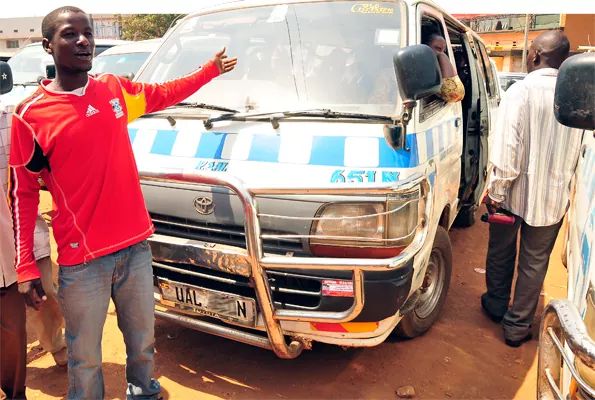
The government’s crackdown on public service vehicles operating in a dangerous mechanical condition has taken effect, with several taxis impounded at Nateete Police Station and a noticeable reduction in the number of taxis operating on Kampala’s roads.
The enforcement operation, targeting vehicles classified as being in a Dangerous Mechanical Condition (DMC), has disrupted normal taxi operations across the capital, leaving some passengers stranded while traffic appeared lighter at some of Kampala’s usually congested junctions.
At Nateete Police Station, several impounded vehicles were seen as traffic officers intensified inspections of taxis and other vehicles suspected to have dangerous mechanical defects.
Some drivers whose vehicles were impounded disputed the enforcement action, claiming they had been intercepted while heading to garages to have mechanical problems repaired.
Others argued that they were stopped over what they considered minor defects, including faulty windscreen wipers.
The drivers’ complaints have raised concerns about how the DMC regulations are being enforced, particularly where vehicles are already being taken for repairs.
However, traffic officers continued with the operation, insisting on compliance with mechanical safety requirements and the possession of mandatory documentation.
Some drivers were also ordered to present their permits. Vehicles whose drivers could not produce the required permits were subsequently impounded.
The operation follows a government directive aimed at removing mechanically unsafe vehicles from the roads in an effort to reduce road crashes and improve road safety.
Fewer taxis on Kampala roads
The impact of the enforcement was particularly visible on Monday, with significantly fewer taxis operating on major roads in Kampala.
At Busega Roundabout, normally one of the city’s busiest and most congested junctions, traffic was flowing more smoothly than usual, with motorists moving without the long queues commonly experienced during peak hours.
Unlike normal days when taxis form a large part of the traffic, only a limited number were seen operating, while private cars and heavy trucks accounted for a greater share of vehicles on the road.
The reduction in taxis, however, has come at a cost to public transport users.
Several passengers were seen stranded along roadsides, waiting for taxis to take them to their respective destinations.
The situation was also evident at taxi parks, where many drivers had opted to park their vehicles rather than risk being intercepted by traffic officers.
Some taxi operators reportedly remained reluctant to enter the city following last week’s directive warning drivers and owners of vehicles in dangerous mechanical condition that they would face enforcement.
Taxi operators call for broader inspections
Joel Bangizi, chairperson of the Mukono Taxi Stage in Nateete Taxi Park, called for the government to strengthen inspections of newly registered vehicles, arguing that some vehicles entering the road network may themselves be contributing to road crashes.
Bangizi also pointed to the poor condition of some roads in Uganda as another factor contributing to road accidents and frequent vehicle breakdowns.
His comments come as taxi operators face increasing pressure to ensure that their vehicles meet roadworthiness requirements while also dealing with deteriorating road infrastructure.
At Nateete Taxi Park, several taxis remained parked as other vehicles underwent mechanical repairs.
The scenes reflected the immediate impact of the government’s enforcement campaign, with operators rushing to address defects or keeping their vehicles off the road to avoid being impounded.
Government stands firm on road safety
The DMC crackdown is part of efforts to ensure that vehicles operating on Uganda’s roads are mechanically fit and do not pose a danger to passengers, motorists and other road users.
Vehicles found with dangerous mechanical defects are being taken off the road, while drivers without the required documentation are also facing enforcement action.
The operation has, however, triggered concerns among taxi operators over the extent of the inspections and whether some vehicles are being penalised for defects that could be addressed through routine repairs.
For passengers, the immediate effect has been a shortage of taxis on some routes, creating delays and leaving some commuters searching for alternative means of transport.
The government’s challenge will now be to maintain the safety objective of the operation while ensuring that enforcement is consistent, transparent and does not unnecessarily disrupt public transport.
With the operation underway, taxi owners and drivers are under pressure to repair defective vehicles and ensure that their documentation is in order before returning to Kampala’s roads.