
Uganda Mirror
  • Big Story
  • News
  • Crime
  • Gossip
  • Politics
  • Business
  • Sports
  • Love & Relationships
  • World
No Result
View All Result
SUBSCRIBE
Uganda Mirror
  • Big Story
  • News
  • Crime
  • Gossip
  • Politics
  • Business
  • Sports
  • Love & Relationships
  • World
No Result
View All Result
Uganda Mirror
No Result
View All Result
Home Business

The Test Uganda Hasn’t Sat Yet

admin by admin
2026/07/06
in Business, Opinions
Reading Time: 8 mins read
0
The Unwritten Deal is Dead: Gen Z is Reshaping Uganda’s Workplace
74
SHARES
1.2k
VIEWS
Share on FacebookShare on Twitter
By Richard Rays Kyorakunde

Global capital is being redirected. Supply chains once anchored in China are dispersing toward Vietnam, Bangladesh, India and parts of Africa; sovereign wealth funds from the Gulf are diversifying into ports, logistics and food systems across the continent; multilateral lenders are recalibrating toward economies that can absorb capital productively. Uganda sits inside this reallocation, and by the headline numbers, it is participating meaningfully. Foreign direct investment reached a record $3.3–3.4 billion in 2024, and coffee export earnings roughly doubled to $2.2–2.4 billion in the 2024/25 season. These are genuine achievements, not statistical artefacts. The question worth asking is not whether Uganda is attracting capital — it plainly is — but whether the country’s industrial policy architecture, much of which already exists on paper, will be enforced with enough discipline once the fiscal space to test it arrives. That is a narrower question than the one usually posed in investment forums, and a fairer one than the one usually posed by Uganda’s critics.

You might also like

Finance Ministry Accounting Officer Dr. Sengonzi Honoured As Uganda’s Public Finance Management Champion

Museveni Demands Answers Over ‘Missing’ Shs51 Billion Meant For World Bank Debt

Makerere Unveils New Five-Year Strategy As Government Bets On Research To Drive Uganda’s $500 Billion Economy

Before First Oil, Judge the Foundation, Not the Building

Uganda has not yet produced a barrel of commercial oil. The Lake Albert development and the East African Crude Oil Pipeline represent the capital-formation phase of a resource economy — pipeline construction, upstream investment, logistics build-out — not its output phase. This matters for how the FDI data should be read. Uganda’s FDI stock has grown from roughly $14 billion in 2019 to over $20 billion by 2024, but the composition is concentrated: oil and gas-linked investment dominates recent inflow growth, and the Netherlands alone accounted for close to 59 percent of 2024 inflows, with France a distant second. This concentration is a legitimate concern, and it should not be waved away as a temporary phase — resource-dependent FDI structures have a documented tendency to persist well past the point at which diversification should have begun. But it is also true that comparing this construction-phase composition to Vietnam’s decades-old, mature manufacturing export base compares two different stages of economic development as though they were contemporaneous. The honest position holds both facts at once: the concentration is real and worth tracking closely, and the sequencing argument is also real and should temper how quickly conclusions are drawn from it.

Uganda’s Economy Is Growing. Its Factories Aren’t Gaining Ground.

Manufacturing value added has held near 15 percent of GDP for several years — a share that, taken alone, invites a stagnation narrative. It shouldn’t be taken alone. GDP has grown at over 6 percent annually across the same period, meaning manufacturing output has expanded substantially in absolute terms even as its

share of a growing economy stayed flat. The more precise and more defensible claim is this: manufacturing is growing, but not gaining share relative to services and extraction — meaning Uganda’s economy is getting bigger without becoming meaningfully more industrialised in relative terms. That is a real diagnosis. It is different from, and more damaging in its way than, claiming manufacturing itself is stagnant, because it points to a structural ceiling rather than a temporary lull.

Namanve Has the Industrial Parks. Agro-Processing Doesn’t Have the Incentives.

It would be inaccurate to suggest Uganda lacks an industrial policy framework. The Namanve, Kapeeka, Mbale and Luzira industrial parks, the Investment Code’s export-incentive provisions, and local-content requirements written into the Petroleum Act and enforced through the Petroleum Authority of Uganda and the Uganda National Oil Company’s procurement rules all exist and predate any current critique. The National Industrial Policy sets explicit value-addition targets. The more precise criticism, and the one that should replace any suggestion of a policy vacuum, is that implementation has been uneven: local-content enforcement is strongest in oil and gas procurement, where it is legally mandated and monitored, and considerably weaker across agro-processing, where value-addition targets exist on paper but incentive structures — a ten-year tax holiday calibrated for investments above $50 million — continue to reward capital-intensive, often extractive projects over the mid-sized, labour-intensive manufacturing that would actually diversify supplier networks. The framework is there. The incentive structure inside it is still pointed at the wrong scale of investment.

Coffee’s “Bean to Beauty” Story Is Real. The Beans Still Leave Green.

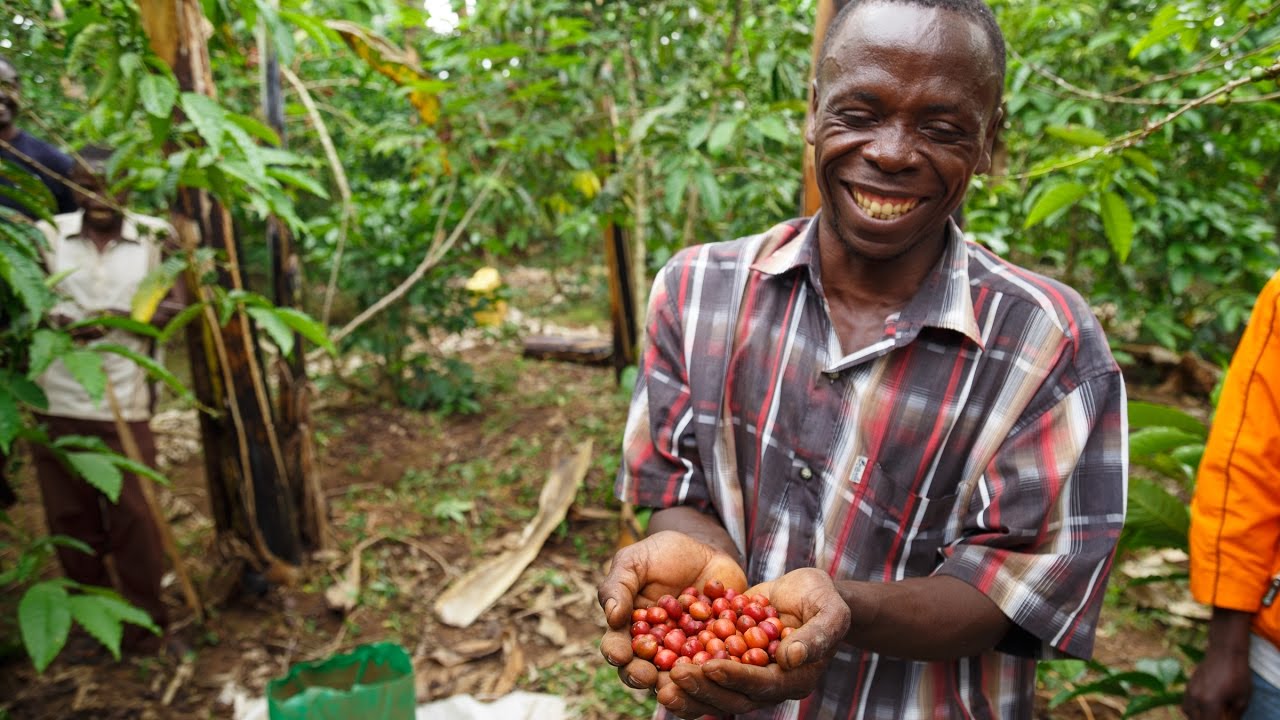
Coffee is Uganda’s best-performing export and its clearest illustration of both progress and its limits. The country shipped roughly 8.4 million bags worth $2.4 billion in the year to October 2025, the largest coffee export performance in its history. The Uganda Coffee Development Authority’s roasting and packaging initiatives, its pivot toward Asian buyers to reduce reliance on European demand, and geospatial farm-registration to meet EU deforestation-compliance rules are active, funded programmes, not aspirations — this transition is genuinely underway. What has not changed is the scale: the overwhelming share of export volume still leaves Uganda as green beans, with roasting and retail margins captured by buyers in Italy and Germany. The accurate claim is not that Uganda has failed to begin moving up the value chain in coffee. It is that the value-addition programme, while real, remains marginal relative to the volume still leaving the country unprocessed — and the gap between programme and scale is the thing worth watching over the next several harvests.

Why Hanoi and Kigali Are the Wrong Mirror — and Addis Is the Right One

Vietnam, Rwanda and Bangladesh are frequently invoked in this debate, and each comparison carries a genuine asymmetry worth naming rather than glossing over. Vietnam sits inside Asia’s densest shipping-lane network; Uganda is landlocked, absorbing Mombasa and Dar es Salaam transit costs on every container. Rwanda manages 13 million people with no resource-curse sequencing problem; Uganda manages 48 million alongside an oil discovery that requires fundamentally different fiscal pacing. Bangladesh’s garment-export growth relied on trade-quota arrangements specific to an era of global trade

policy that no longer exists to replicate. None of these asymmetries excuse slower industrial upgrading, but a fairer comparator is Ethiopia — landlocked-adjacent, a large population, a state-directed industrial-park model, and a comparable starting GDP per capita a decade ago. Ethiopia’s experience is instructive precisely because it has not been a clean success: several industrial parks have struggled with occupancy and debt sustainability, a cautionary case Uganda should study in detail before scaling its own park model further, rather than treating industrial parks themselves as a guaranteed solution.

The Netherlands, the Oil, and a Shrinking COMESA — What’s Actually at Stake

The concentration of Uganda’s FDI in oil and gas, the decline in intra-regional COMESA investment — down from 15 percent of greenfield project count in 2019 to 12 percent by 2024, and from 12 percent to just 5 percent by value — and the gap between agro-processing policy and agro-processing enforcement are not contestable points; they are documented in Uganda’s own investment-climate data and in UNCTAD’s regional reporting. The question worth debating is not whether these problems exist, but whether Uganda’s current sequencing — oil capital first, industrial diversification enforcement second — is a defensible strategy given where the country sits in the resource-development cycle, or whether the enforcement gap in agro-processing and manufacturing incentives should be closed now, ahead of First Oil, rather than treated as a problem for the post-oil fiscal surplus to solve.

The Test Uganda Hasn’t Sat Yet

Uganda’s investment story is neither the straightforward success suggested by record FDI headlines nor the structural failure implied by comparing a construction-phase resource economy to mature manufacturing exporters a generation ahead of it. It is a country with a genuine industrial policy framework, uneven enforcement of that framework outside the oil sector, and a narrowing window — the same global capital reallocation toward the Global South that is not guaranteed to remain this generous — in which to close the gap between policy design and policy discipline before First Oil determines whether Uganda diversifies or simply industrializes its extraction. That is the test that has not yet been sat. How it is answered, more than any FDI figure published this year, will determine what Uganda’s economy looks like a decade from now.
Tags: FeaturedFirst oilRichard Rays Kyorakundeuganda
Share30Tweet19
Previous Post

Former Speaker Anita Among To Be Arraigned Before Anti-Corruption Court

Next Post

Works Minister Gives Contractor One Week Ultimatum To Finish Northern Bypass Repairs

Recommended For You

Finance Ministry Accounting Officer Dr. Sengonzi Honoured As Uganda’s Public Finance Management Champion

by Ritah Kengonzi
July 6, 2026
0
Finance Ministry Accounting Officer Dr. Sengonzi Honoured As Uganda’s Public Finance Management Champion

The Undersecretary and Accounting Officer at the Ministry of Finance, Planning and Economic Development, Dr. Sengonzi Damulira, has been recognised as Uganda's Public Finance Management Champion in recognition...

Read moreDetails

Museveni Demands Answers Over ‘Missing’ Shs51 Billion Meant For World Bank Debt

by admin
July 3, 2026
0
Uganda Launches 2026 Presidential Campaigns as Eight Candidates Hit the Trail

An explosive letter purportedly signed by President Yoweri Museveni has placed the Ministry of Finance under intense scrutiny over the alleged diversion of US$14 million (about Shs51 billion)...

Read moreDetails

Makerere Unveils New Five-Year Strategy As Government Bets On Research To Drive Uganda’s $500 Billion Economy

by Ritah Kengonzi
July 2, 2026
0
Makerere Unveils New Five-Year Strategy As Government Bets On Research To Drive Uganda’s $500 Billion Economy

The Ugandan government has challenged Makerere University to become a powerhouse of policy research, innovation and technological advancement capable of driving the country's ambitious plan to grow its...

Read moreDetails

Finance Ministry Unveils FY2026/27 Fiscal Strategy, Targets Shs 45.6 Trillion Revenue Boost and Stricter Spending Controls

by Ritah Kengonzi
July 1, 2026
0
Finance Ministry Unveils FY2026/27 Fiscal Strategy, Targets Shs 45.6 Trillion Revenue Boost and Stricter Spending Controls

The Ministry of Finance, Planning and Economic Development has outlined an ambitious fiscal policy framework for the Financial Year 2026/27, signalling a sharper focus on revenue expansion, tighter...

Read moreDetails

Finance Minister Pushes For Faster Implementation Of World Bank-Funded Projects As Uganda’s Portfolio Hits $4.72 Billion

by Ritah Kengonzi
June 26, 2026
0
Finance Minister Pushes For Faster Implementation Of World Bank-Funded Projects As Uganda’s Portfolio Hits $4.72 Billion

Finance Minister Henry Musasizi has called for urgent improvements in the implementation of World Bank-funded projects, warning that Uganda's development agenda is being slowed by poor project execution...

Read moreDetails
Next Post
Works Minister Gives Contractor One Week Ultimatum To Finish Northern Bypass Repairs

Works Minister Gives Contractor One Week Ultimatum To Finish Northern Bypass Repairs

Please login to join discussion

Related News

Finance Ministry Accounting Officer Dr. Sengonzi Honoured As Uganda’s Public Finance Management Champion

Finance Ministry Accounting Officer Dr. Sengonzi Honoured As Uganda’s Public Finance Management Champion

2 hours ago
Works Minister Gives Contractor One Week Ultimatum To Finish Northern Bypass Repairs

Works Minister Gives Contractor One Week Ultimatum To Finish Northern Bypass Repairs

3 hours ago
The Unwritten Deal is Dead: Gen Z is Reshaping Uganda’s Workplace

The Test Uganda Hasn’t Sat Yet

3 hours ago
From Done Deal to ‘We Shall Discuss’: Anita Among’s Seat Suddenly Develops Wheels

Former Speaker Anita Among To Be Arraigned Before Anti-Corruption Court

3 hours ago
NARO Beats Government Agencies To Win Top Honour At Jinja Agricultural Show

NARO Beats Government Agencies To Win Top Honour At Jinja Agricultural Show

4 hours ago
I was rigged in Kampala – Museveni

Denying Your Partner Sex Is An Offence — Museveni

2 days ago

Popular Stories

  • Government Unveils Japanese Climate-Smart Technology To Help Ugandan Farmers Beat Drought

    Government Unveils Japanese Climate-Smart Technology To Help Ugandan Farmers Beat Drought

    709 shares
    Share 284 Tweet 177
  • Parliament Works  Enter Final Phase, 3M Kg Steel Installed

    677 shares
    Share 271 Tweet 169
  • High Court to Hear Habeas Corpus Case As Citizens Petition Museveni Over Sanyu Edisah’s Alleged Detention

    672 shares
    Share 269 Tweet 168
  • Uganda Receives Three Massive Transformers To Power EACOP And Hoima Industrial Hub

    635 shares
    Share 254 Tweet 159
  • MTN Uganda Ordered To Pay Shs2.3 Billion After Court Finds It Framed Whistleblower In Shs16bn Mobile Money Fraud Case

    595 shares
    Share 238 Tweet 149
  • Judith Heard Advises Stella Nantumbwe To Handle Marriage Fallout With Dignity And Silence

    590 shares
    Share 236 Tweet 148
  • INTERNET ON FIRE: Chameleone’s Son Abba Marcus Sex Tape With Girlfriend Angel Leaks

    547 shares
    Share 219 Tweet 137
Facebook Twitter Instagram Youtube
Uganda Mirror

Uganda's leading source News in categories of Politics Gossip Crime Sports Business Technology & Education

© 2025 Ug Mirror - A Product of Mirror Digital Limited .

We use cookies on our website to give you the most relevant experience by remembering your preferences and repeat visits. By clicking “ACCEPT ALL”, you consent to the use of ALL the cookies. However, you may visit "Cookie Settings" to provide a controlled consent.
Cookie SettingsREJECT ALLACCEPT ALL
Manage consent

Privacy Overview

This website uses cookies to improve your experience while you navigate through the website. Out of these, the cookies that are categorized as necessary are stored on your browser as they are essential for the working of basic functionalities of the website. We also use third-party cookies that help us analyze and understand how you use this website. These cookies will be stored in your browser only with your consent. You also have the option to opt-out of these cookies. But opting out of some of these cookies may affect your browsing experience.
Necessary
Always Enabled
Necessary cookies are absolutely essential for the website to function properly. These cookies ensure basic functionalities and security features of the website, anonymously.
CookieDurationDescription
cookielawinfo-checkbox-analytics11 monthsThis cookie is set by GDPR Cookie Consent plugin. The cookie is used to store the user consent for the cookies in the category "Analytics".
cookielawinfo-checkbox-functional11 monthsThe cookie is set by GDPR cookie consent to record the user consent for the cookies in the category "Functional".
cookielawinfo-checkbox-necessary11 monthsThis cookie is set by GDPR Cookie Consent plugin. The cookies is used to store the user consent for the cookies in the category "Necessary".
cookielawinfo-checkbox-others11 monthsThis cookie is set by GDPR Cookie Consent plugin. The cookie is used to store the user consent for the cookies in the category "Other.
cookielawinfo-checkbox-performance11 monthsThis cookie is set by GDPR Cookie Consent plugin. The cookie is used to store the user consent for the cookies in the category "Performance".
viewed_cookie_policy11 monthsThe cookie is set by the GDPR Cookie Consent plugin and is used to store whether or not user has consented to the use of cookies. It does not store any personal data.
Functional
Functional cookies help to perform certain functionalities like sharing the content of the website on social media platforms, collect feedbacks, and other third-party features.
Performance
Performance cookies are used to understand and analyze the key performance indexes of the website which helps in delivering a better user experience for the visitors.
Analytics
Analytical cookies are used to understand how visitors interact with the website. These cookies help provide information on metrics the number of visitors, bounce rate, traffic source, etc.
Advertisement
Advertisement cookies are used to provide visitors with relevant ads and marketing campaigns. These cookies track visitors across websites and collect information to provide customized ads.
Others
Other uncategorized cookies are those that are being analyzed and have not been classified into a category as yet.
SAVE & ACCEPT
No Result
View All Result
  • Big Story
  • News
  • Crime
  • Gossip
  • Politics
  • Business
  • Sports
  • Love & Relationships
  • World

© 2025 Ug Mirror - A Product of Mirror Digital Limited .

This website uses cookies. By continuing to use this website you are giving consent to cookies being used. Visit our Privacy and Cookie Policy.
Not enough quota to unlock this post
Unlock left : 0
Are you sure want to cancel subscription?