
Uganda is intensifying efforts to develop Excelsa coffee, a little-known indigenous coffee species that scientists believe could transform the country’s coffee industry through climate resilience, biodiversity conservation and market diversification.
Researchers from the National Agricultural Research Organisation, through the National Agricultural Research Laboratories, are leading a nationwide push to generate scientific evidence and organise the value chain for Excelsa coffee, which has remained largely underutilised despite growing global interest in climate-smart crops.
The renewed focus comes as Uganda seeks to strengthen its position as Africa’s leading coffee exporter while responding to increasing threats posed by climate change to traditional coffee species such as Robusta and Arabica.
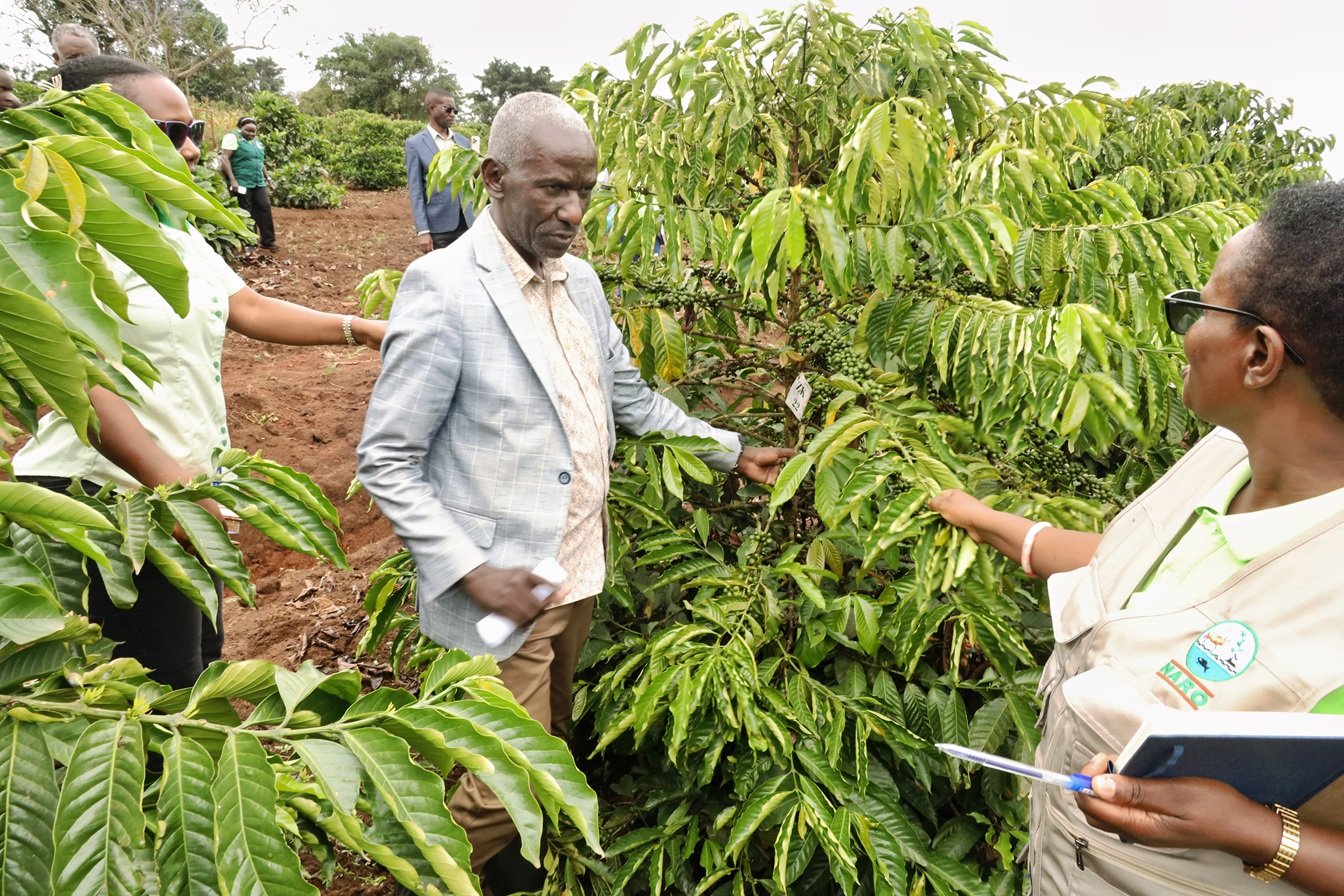
Speaking during a recent visit to one of the trial fields in Kamenyamiggo, Lwengo District, NARO Director General Yona Baguma said Uganda must approach the development of Excelsa coffee cautiously and scientifically.
“Excelsa coffee presents an important opportunity for Uganda, but we must approach it carefully and scientifically. Farmers already have valuable knowledge about the crop, while researchers must generate the evidence needed to support conservation, planting material development, quality profiling and market positioning,” Dr. Baguma said.
He noted that successful establishment of the crop would significantly expand Uganda’s coffee base beyond the dominant Robusta and Arabica varieties.
On Thursday, scientists, farmers and private sector actors converged at Kawanda for a major engagement aimed at assessing the commercial and scientific potential of Excelsa coffee under a project dubbed “Development of Excelsa Coffee under Global Change.”
The initiative is being implemented through a partnership involving NARO, Royal Botanic Gardens, Kew, Makerere University and Kyagalanyi Coffee Limited, with funding support from the Calleva Foundation.
According to lead scientist Catherine Kiwuka, Excelsa coffee — scientifically known as Coffea dewevrei and locally referred to as “Kisansa” by some farmers — naturally occurs in areas such as the Zoka Central Forest Reserve and Semuliki National Park.
Researchers say the species possesses unique characteristics that could make it more adaptable to changing climatic conditions while also contributing to conservation of Uganda’s rich coffee biodiversity.
During the farmer-scientist interface, participants toured an on-station field trial where they observed different Excelsa varieties and exchanged practical experiences on cultivation, flowering patterns, fruiting behaviour, disease resistance and crop management.
Farmers also raised concerns about limited access to quality planting materials, uncertain markets, processing challenges and the absence of clear information on the crop’s commercial viability.
Scientists acknowledged that one of the biggest hurdles facing Excelsa coffee development is the crop’s high genetic variability. Researchers say many different types are currently known by farmers but have not yet been formally characterised, making it difficult for exporters and buyers to guarantee consistent quality and supply.
To address this, NARO plans to document farmer knowledge, identify promising genetic materials, assess cup quality and evaluate production performance in order to establish a more structured value chain.
The scientists also aim to identify a smaller number of promising Excelsa lines that can be scientifically studied, multiplied and prepared for commercial production.
Dr. Kiwuka stressed that the future of Excelsa coffee must be driven by science, market realities and farmer experience.
“The crop cannot be promoted sustainably without evidence on agronomy, adaptation, quality, processing, farmer incentives and buyer requirements,” she said.
NARO officials say the ongoing work forms part of a broader national strategy to integrate Excelsa coffee into Uganda’s coffee research and development agenda, with expectations that it could eventually attract investment, strengthen exports and provide farmers with alternative income opportunities.
Robooni Tumuhimbise, Director of Research at NARO-NaRL, said the initiative demonstrates the importance of collaboration between researchers, farmers and value-chain actors in shaping Uganda’s agricultural future.
“This engagement is important because it brings farmers, researchers and value-chain actors together to shape a practical agenda for Excelsa coffee,” he said.