

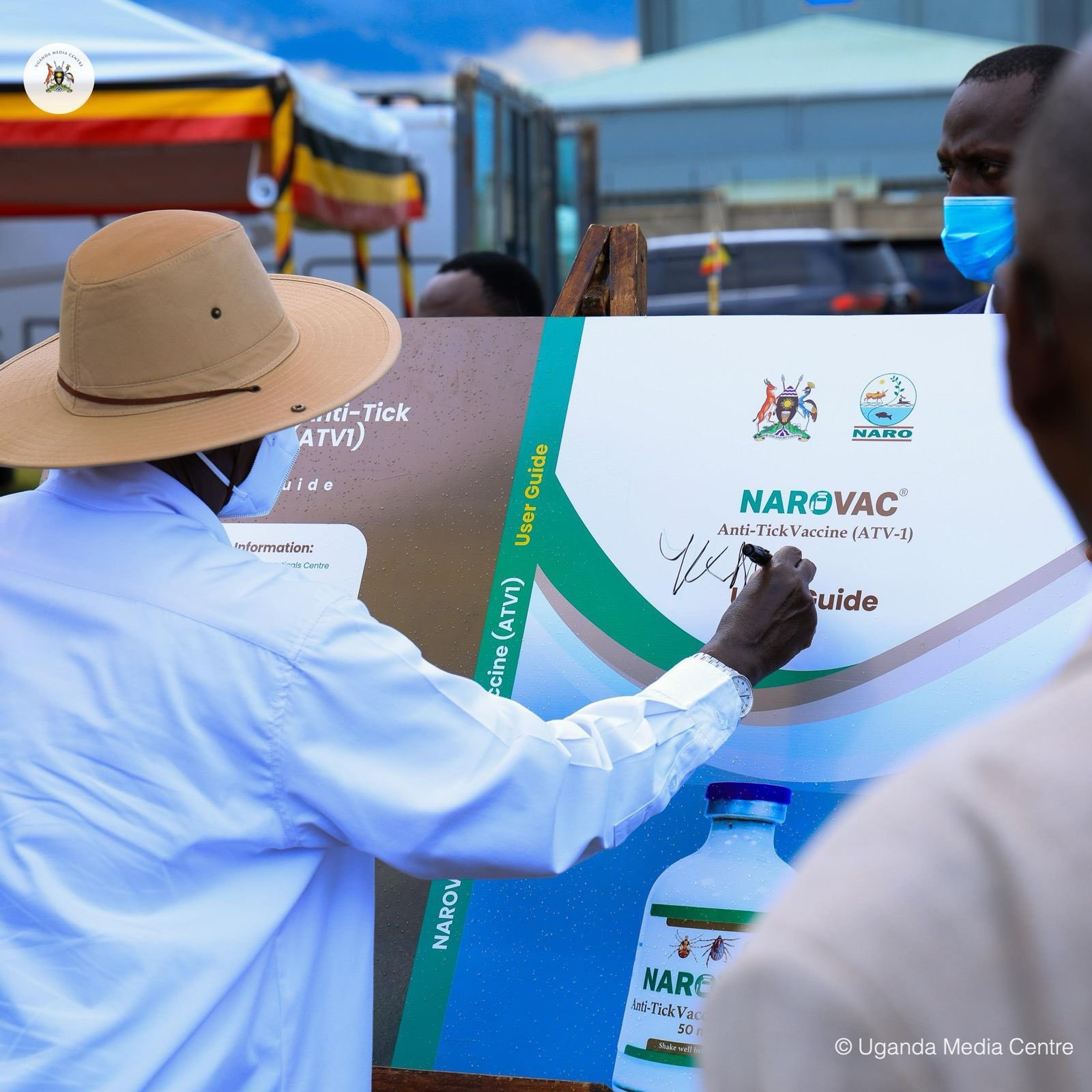
President Yoweri Kaguta Museveni has commissioned Uganda’s first locally developed anti-tick vaccine, marking a major breakthrough in the country’s livestock sector and scientific innovation.
The vaccine, named NAROVAC-ATV1, was unveiled on Friday at the National Livestock Resources Research Institute in Namulonge. It is designed to combat tick-borne diseases, which have long posed a serious threat to cattle farmers across Uganda.
Speaking at the commissioning, Museveni described the development as a “lasting solution” to a problem that has significantly affected livestock productivity and farmers’ incomes. “The cow now kills the tick,” he said, emphasizing the vaccine’s role in reversing the long-standing burden of tick infestations.
Tick-borne diseases have historically forced farmers to rely on chemical acaricides, which can be costly and harmful when misused. According to the President, the introduction of NAROVAC-ATV1 will reduce dependence on these toxic chemicals, lower the cost of livestock production, and improve the overall health of Uganda’s cattle population.
Museveni also hailed the innovation as part of Uganda’s broader shift toward science-led development. He commended local scientists for their work and reiterated the government’s commitment to investing in research and innovation as a driver of national transformation.
The launch of the vaccine is expected to boost confidence among cattle keepers and strengthen Uganda’s agricultural sector, which remains a backbone of the country’s economy. Experts say the breakthrough could position Uganda as a leader in veterinary science within the region, while improving livelihoods for thousands of farmers.
The government has pledged continued support to research institutions to ensure more homegrown solutions are developed to address key challenges in agriculture and beyond.