

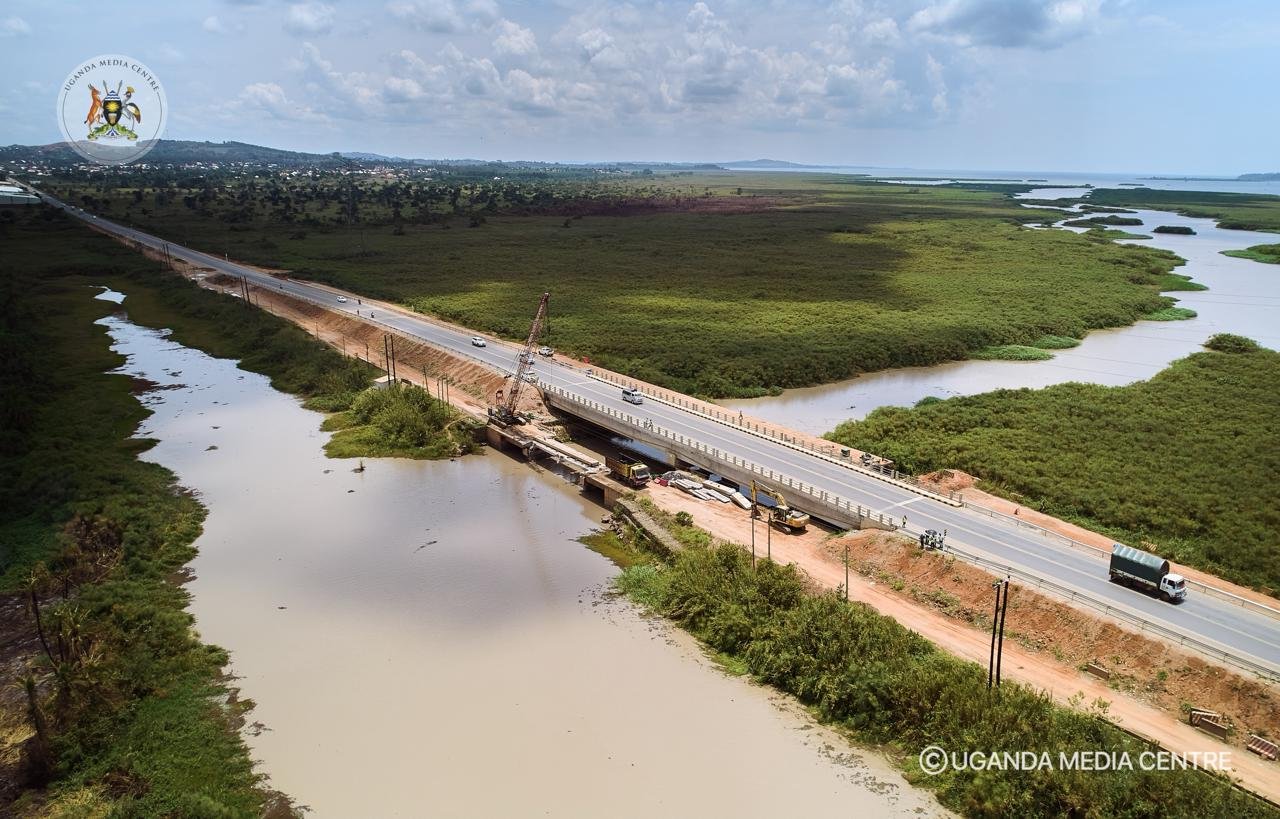
Traffic along the Kampala–Masaka Highway is set for a major boost after the newly reconstructed Katonga Bridge was restored and opened to motorists, marking the end of a more than three-year disruption caused by the collapse of the old bridge.
The new Katonga Bridge is reported to be 100 percent complete, with the reconstructed structure designed to withstand flooding and improve the reliability of one of Uganda’s busiest transport corridors.
The bridge was destroyed in May 2023 after heavy rains and flash floods swept through the Katonga area, cutting one of the country’s major highways and forcing motorists to rely on lengthy alternative routes.
The disruption affected the movement of passengers, agricultural produce and commercial cargo between Kampala and southwestern Uganda, with traders and transport operators facing longer journeys and increased operating costs.
Government subsequently embarked on an emergency reconstruction programme covering Katonga as well as flood-prone sections at Lwera and Kalandazi.
The project was awarded to China Communications Construction Company (CCCC) under a Design and Build arrangement. Government documents put the overall project allocation at approximately Shs191 billion, covering the reconstruction of the bridge and works along affected sections of the Kampala–Masaka road.
The new bridge was deliberately designed differently from the structure that was swept away.
In 2024, Works and Transport Minister Gen. Edward Katumba Wamala said government had studied the behaviour of the Katonga River and weather patterns before settling on a new structure capable of withstanding future flooding.
“We had to study the meteorological behaviours of that river so that we can make a new structure which is resilient and will stand the test of time,” Katumba said during a parliamentary briefing.
Construction progressed through 2025 and 2026, with the main bridge structures, deck and approach roads gradually taking shape.
By May 2026, contractors were carrying out final works on the approaches, with the Ministry of Works and Transport warning motorists about temporary traffic restrictions as asphalt surfacing was completed.
The project has also involved improvements intended to address the wider flooding problems along the corridor, particularly around Lwera and Kalandazi, where flooding has repeatedly disrupted traffic.
The Kampala–Masaka Highway is a critical transport and trade route linking Kampala with Masaka and onward to southwestern Uganda and neighbouring countries. The road carries substantial volumes of passenger vehicles, trucks and trailers.
The restoration of Katonga therefore removes one of the major bottlenecks created by the 2023 floods and restores a more direct connection between Kampala and Masaka.
The reopening is expected to ease traffic pressure, shorten journeys and improve the movement of goods along the corridor.
However, the completion of Katonga comes after years of disruption in which motorists had to contend with temporary bridges, diversions and congestion while waiting for a permanent solution.
With the new bridge now open, attention will shift to ensuring that the wider Kampala–Masaka corridor, including the flood-prone Lwera and Kalandazi sections, remains reliable during periods of heavy rainfall.
The restoration of Katonga marks a significant milestone in government’s efforts to rebuild infrastructure damaged by the 2023 floods and create transport infrastructure capable of coping with increasingly severe flooding events.