
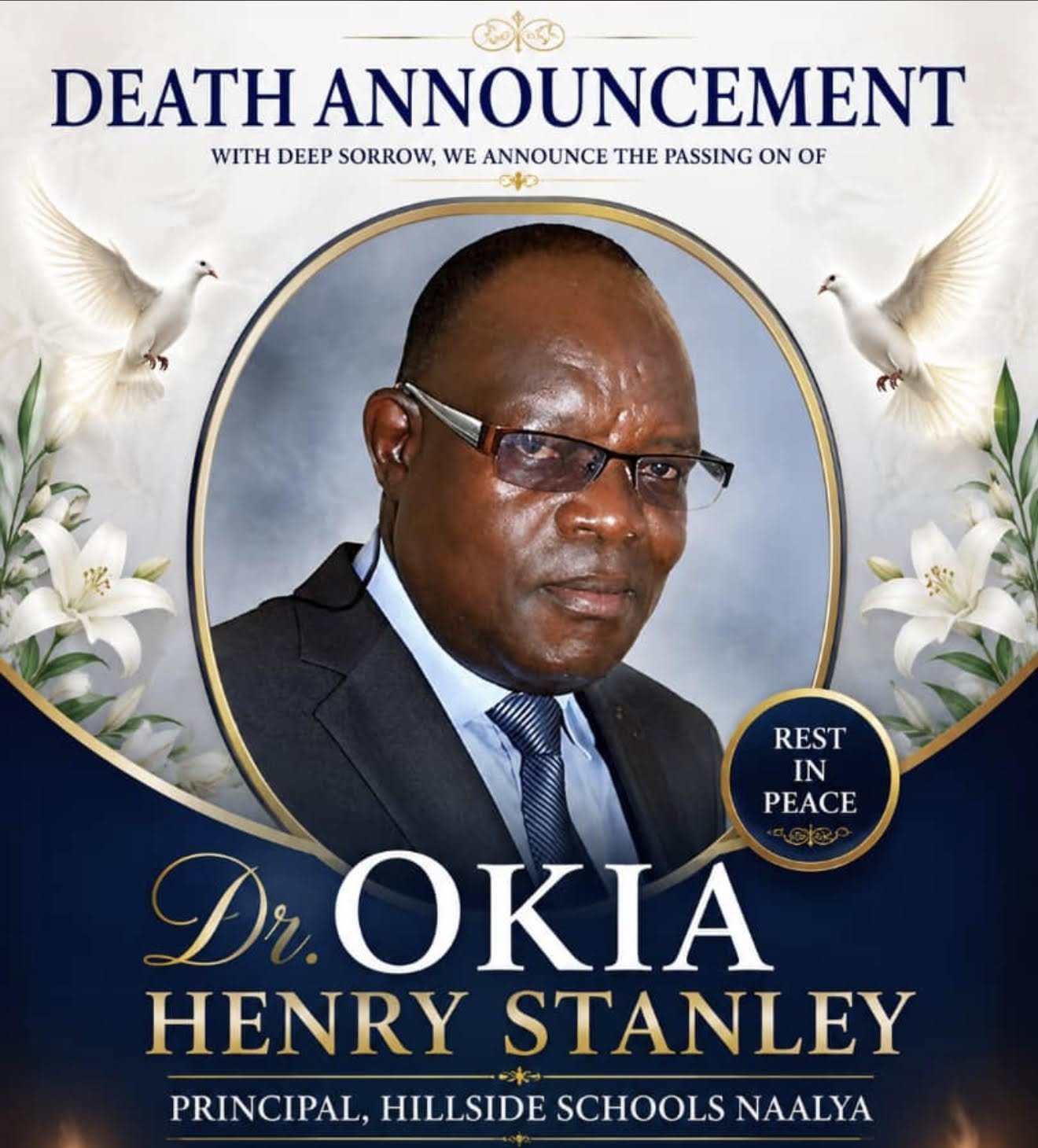
Case Hospital has confirmed that longtime Hillside Schools Naalya principal Dr Henry Stanley Okia died at the facility on Thursday, August 20, 2026, but has declined to disclose the medical circumstances surrounding his death, citing patient confidentiality.
The hospital’s statement, dated August 23, 2026, comes amid growing public interest and conflicting accounts surrounding the sudden death of the veteran educationist, who had spent more than four decades in Uganda’s education sector.
Case Hospital said its attention had been drawn to reports circulating on social media concerning Dr Okia’s death and confirmed that he was a patient at the facility.
“We are deeply saddened by the loss of our patient and extend our sincere condolences to his family, friends and the community he served,” the hospital said.
However, the hospital made clear that it would not discuss the details of his treatment publicly.
“Our unwavering commitment to patient privacy prevent us from discussing specific clinical details of our patients on social media or any other media channel,” management said.
The hospital added that its doctors had provided Dr Okia’s family with a full medical report, effectively placing the official medical explanation for his death in the hands of his relatives rather than the public.
Questions over what happened at Case Hospital
The hospital’s clarification is significant because accounts published since Dr Okia’s death have differed over the circumstances leading to his final moments.
Initial reports indicated that the Hillside principal had gone to a medical facility for a check-up after experiencing cardiovascular concerns and subsequently collapsed.
According to Daily Monitor, Hillside administrator Shamsidin Semugenyi said Dr Okia appeared to be in good health during the school’s Cultural Day on August 15, just five days before his death.
“He was really okay. During the preparations for the event, he was very jolly. He did not seem to be experiencing any serious problem,” Semugenyi was quoted as saying.
Semugenyi said he later learnt that Dr Okia had been experiencing some heart-related problems and was due for a medical examination.
He reportedly collapsed shortly after arriving at the medical facility.
“When he went to the hospital for the check-up, the doctors examined him and told him to wait for a little while. After about 10 minutes of arriving at the hospital, he collapsed,” Semugenyi said.
Other reports have subsequently described his death as occurring after a heart operation, while some have referred to a sudden cardiac event.
New Vision reported that Dr Okia died at Case Hospital on Thursday morning shortly after undergoing a heart operation.
But Case Hospital’s own statement does not confirm that account, nor does it disclose what procedure, if any, was performed.
Instead, the hospital stressed that the clinical details contained in the medical report were a private matter between its doctors and the deceased’s family.
Hospital rejects public discussion of clinical details
The statement appears aimed at drawing a line under speculation about Dr Okia’s treatment.
Case Hospital said its medical team provided “high-quality, dedicated care” to Dr Okia from the moment he was admitted.
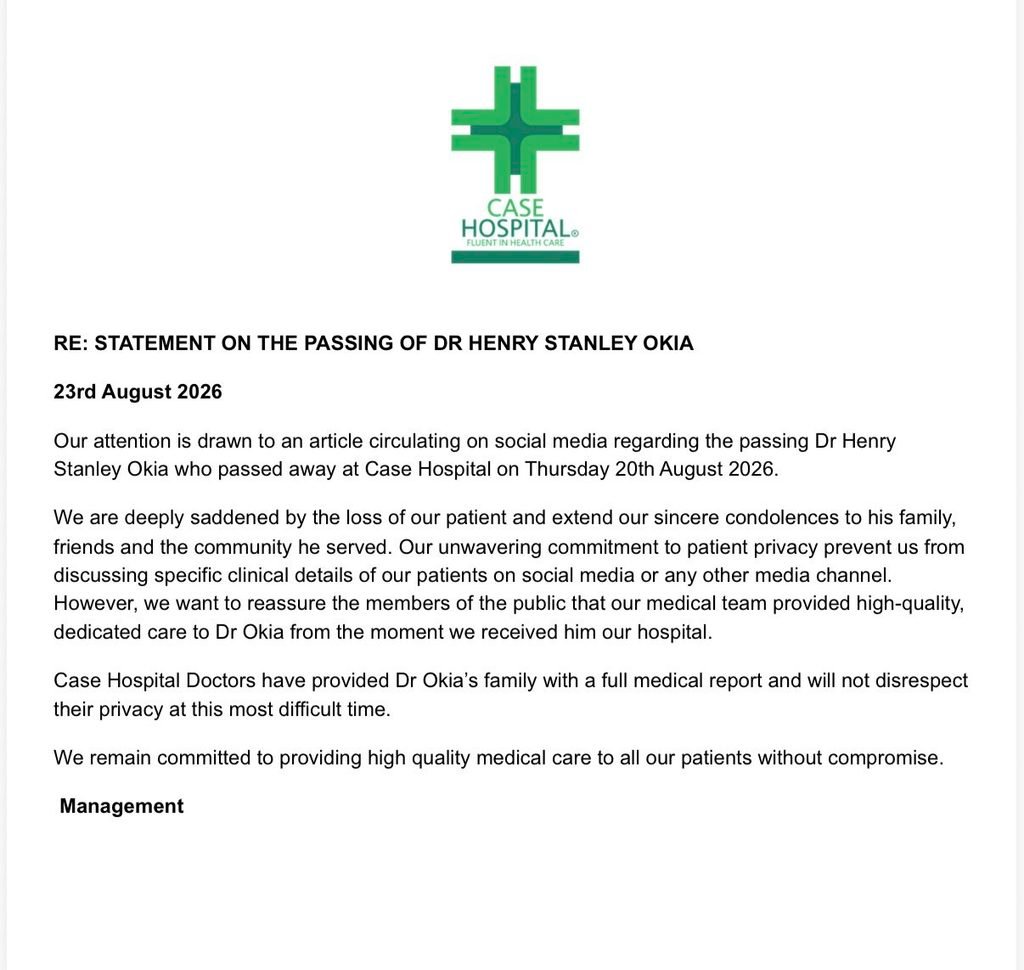
The management also rejected any suggestion that it would publicly debate the patient’s treatment, saying it would continue to respect the family’s privacy “at this most difficult time.”
“We remain committed to providing high quality medical care to all our patients without compromise,” the hospital said.
The statement does not accuse any media organisation or individual of wrongdoing, but it comes after reports and social media discussions began raising questions about what happened to the educationist during his final hours.
Family now holds the medical report
The most definitive new piece of information is that Dr Okia’s family has received a full medical report from Case Hospital.
This means that, unless the family chooses to release the report or provide details from it, the exact medical cause of death may remain private.
Case Hospital has also not publicly attributed blame to any individual medical practitioner or indicated that there was an adverse incident during treatment.
Similarly, the hospital has not confirmed or denied reports suggesting that a procedure preceded Dr Okia’s death.
That distinction is important because reports about his final hours remain allegations or accounts from sources unless independently confirmed by the family or medical records.
A career spanning more than four decades
Dr Okia’s death has nevertheless triggered widespread mourning because of his unusually long career in education.
He began his professional journey in 1980, when he joined Namutamba Primary Teachers’ College in Mityana District. He qualified as a Grade Two teacher in 1984 and was posted to Narambhai Road Primary School in Jinja District.
He subsequently moved to Nakasero Primary School, where he taught Social Studies, Religious Education and English Language until 1996.
In 1997, he moved into private education, becoming head teacher at Lakeside Academy Primary School in Bugonga, Entebbe. He later helped establish Entebbe Junior School before joining Hillside Schools Naalya.
He eventually became the principal of Hillside Schools Naalya, where he remained for more than two decades.
By 2024, Daily Monitor reported that he had spent about 23 years in the school’s leadership.
PhD holder who never abandoned the classroom
Dr Okia’s rise from a Grade Two teacher to a PhD holder was one of the defining features of his career.
He graduated from Kyambogo University in 2023 with a Doctor of Philosophy in Education, after researching support supervision and teacher performance in government-aided primary schools in Uganda’s Teso sub-region.
His research examined whether supervision of teachers was being used primarily as a monitoring and standards-enforcement mechanism or as a tool for professional development.
His findings argued for greater emphasis on mentoring teachers, building competence and improving professional performance.
Despite attaining a doctorate, Dr Okia continued to identify strongly as a primary school teacher.
In a 2024 interview, he said he sometimes entered Primary Seven classrooms to help learners understand lessons, particularly Social Studies and Religious Education.
He described primary education as his area of specialisation, saying that remaining at that level had given him extensive knowledge of teaching, learning, planning and institutional management.
His final public appearance came days before his death
One of the striking aspects of Dr Okia’s death is how shortly before his passing he had appeared publicly in good health.
He attended Hillside Schools Naalya’s Cultural Day on August 15, where parents and members of the school community interacted with him.
New Vision reported that Prof Godfrey Akileng, a parent at the school, remembered the principal for the special attention he gave parents during the event.
Five days later, the veteran educator was dead.
His sudden passing has left parents, teachers, former pupils and fellow educationists struggling to reconcile his active appearance at the school event with the events that unfolded at the hospital.
Leaders and educationists mourn
The death has attracted tributes from senior figures, including Vice President Jessica Alupo, who mourned Dr Okia and recalled recently discussing plans to establish a private primary and secondary school in Katakwi District with him.
Friends and colleagues have similarly described him as a visionary school leader, mentor and advocate for academic excellence.
Tom Okwenyi, identified as a close friend, said Dr Okia’s contribution extended beyond Hillside Schools to learners, teachers and the wider education community.
His influence also extended into education research and publishing. He authored the Pioneer Social Studies Revision Workbook for Primary Four to Seven learners, published in 2025.
What remains unanswered
With Case Hospital now confirming that Dr Okia died at the facility but refusing to disclose clinical details, several questions about his final hours remain unanswered publicly.
These include the precise nature of the medical condition that brought him to hospital, what treatment he received and what ultimately caused his death.
However, the hospital has indicated that these answers are contained in the medical report handed to his family.
For now, the institution has insisted that Dr Okia’s medical information will remain confidential.
The hospital’s statement therefore puts the focus on the family, which may decide whether any further details should be made public.
What is already beyond dispute is the scale of the loss to Uganda’s education sector.
Dr Okia spent more than 40 years teaching, mentoring and managing schools, rising from a Grade Two classroom teacher to a school principal, education researcher and PhD holder.
His death on August 20 has brought that long journey to an abrupt end, while his final medical chapter remains a private matter between his family and the doctors who treated him.