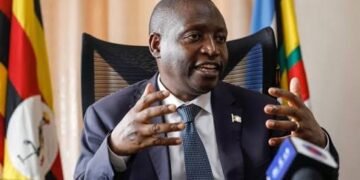

The recent appointment of former East African Legislative Assembly (EALA) by-election contestant Hon. Juma Witonze Kisekka as Minister of State for Internal Affairs has ignited fresh debate within National Resistance Movement (NRM) circles over whether candidates who performed strongly in the EALA race should be considered for senior government appointments.
Political observers and supporters of some of the unsuccessful candidates argue that Witonze’s elevation demonstrates that strong performances during the competitive parliamentary election can enhance an individual’s prospects for future deployment into public service.
Witonze, who finished third in the highly contested EALA by-election before later being appointed to Cabinet by President Yoweri Kaguta Museveni, has become the latest example cited by supporters who believe the appointing authority values candidates who enjoy broad backing among Members of Parliament.
Attention has now shifted to two other candidates who tied in fourth position during the election—former State Minister Godfrey Kiwanda Suubi and public administrator Davis Akampurira—with some NRM supporters urging that they also be considered for future executive or diplomatic responsibilities.
Competitive election
The EALA election attracted an unusually large field of 43 candidates competing for Uganda’s available seats in the regional Parliament, making it one of the most competitive internal political contests in recent years.
Political analysts note that candidates who secured significant support from legislators despite the crowded field demonstrated an ability to build coalitions across different political interests.
Supporters of Kiwanda and Akampurira argue that their performances reflected confidence among MPs in their leadership credentials and experience.
“The EALA election is not merely a popularity contest,” one political analyst observed. “It requires candidates to engage legislators across party lines, explain their vision and convince Members of Parliament that they can effectively represent Uganda at the regional level.”
Analysts caution, however, that parliamentary vote totals alone do not determine appointments to executive office, which remain the constitutional prerogative of the President.
Spotlight on Godfrey Kiwanda
Among those attracting renewed attention is Godfrey Kiwanda Suubi, a seasoned NRM politician with years of experience in both Parliament and Cabinet.
Kiwanda previously served as State Minister for Tourism and has remained active within the ruling party’s leadership structures, including the NRM Central Executive Committee.
Supporters describe him as one of the party’s experienced mobilizers whose institutional knowledge could still be valuable in government or diplomatic assignments.
They argue that his long service within the Movement, coupled with his performance in the EALA race, positions him as one of the individuals deserving consideration whenever vacancies arise.
Political commentators note that Kiwanda’s career has seen him occupy various leadership positions, giving him experience in public administration, political mobilization and legislative affairs.
His supporters believe these credentials could be useful in future executive deployments should the appointing authority decide to tap into experienced party cadres.
Akampurira’s credentials
The conversation has also drawn attention to Davis Akampurira, whose supporters describe him as a long-serving NRM cadre with an extensive record in youth leadership and public administration.
According to supporters, Akampurira has served in various capacities over nearly two decades, including as Uganda National Students Association (UNSA) President, Makerere University NRM Chairman, National Youth Council Secretary for External Relations and Project Coordinator at the Uganda Industrial Research Institute (UIRI).
They argue that these roles have equipped him with administrative experience and an understanding of both youth affairs and government operations.
Supporters further point to his international engagements, particularly his reported connections with institutions in Russia, as experience that they believe could be beneficial should Uganda seek to strengthen diplomatic or economic partnerships.
Some of his supporters have even referred to him using the nickname “Putin’s African Son,” although this is an informal label used by admirers rather than an official title.
Political analysts caution that while international exposure can be an asset, appointments to diplomatic positions are influenced by a wide range of factors, including government priorities, professional qualifications and national interests.
Wider implications
Beyond the individuals involved, the discussion has reignited broader debate about how governments recognize loyalty, political performance and service within party structures.
Some NRM supporters argue that rewarding high-performing candidates who narrowly miss election can encourage continued participation in internal democratic processes.
Others contend that executive appointments should remain focused on addressing the country’s governance priorities, regardless of electoral performance.
Political scientist observations suggest that successful governments often balance political considerations with technical competence when making appointments.
“The President has historically considered several factors when making appointments,” one analyst said. “Experience, regional balance, institutional needs, loyalty, competence and strategic priorities all play a role.”
Looking ahead
With speculation continuing over future appointments of Permanent Secretaries, ambassadors and deputy ambassadors, political observers expect discussions surrounding potential candidates to remain active.
However, no official communication has been issued indicating that Kiwanda, Akampurira or any other EALA contestants are under consideration for specific positions.
For now, the debate remains largely within political circles, with supporters making their case while awaiting any decisions from the appointing authority.
Whether strong performances in the EALA by-election ultimately translate into future government appointments remains uncertain. Nevertheless, Witonze’s appointment has undoubtedly fuelled renewed conversation about the political significance of the regional parliamentary elections and how they may influence perceptions of leadership within the ruling Movement.