
President Yoweri Kaguta Museveni has thrown Uganda’s weight behind a proposed multi-billion-dollar regional oil refinery project championed by Nigerian billionaire industrialist Aliko Dangote, in a move expected to reshape East Africa’s energy landscape.
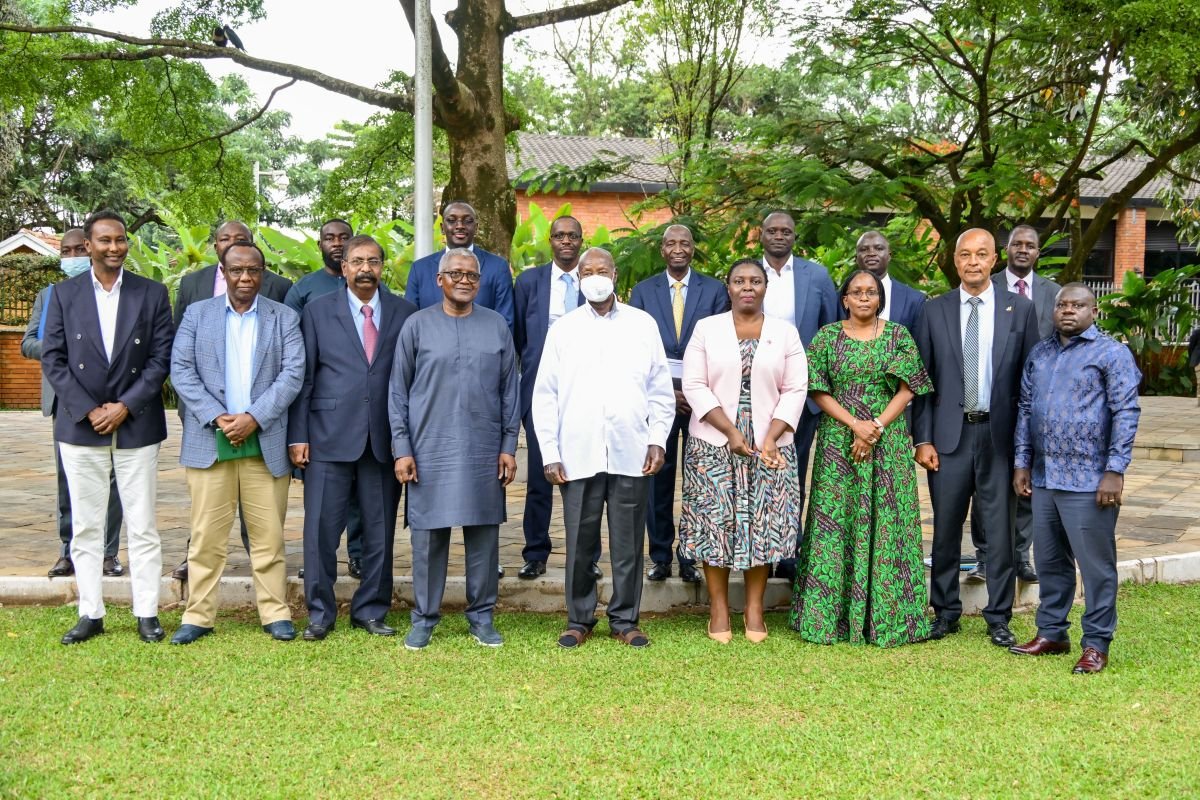
During a high-level meeting held Saturday at State Lodge Nakasero, President Museveni said Uganda was prepared to support the establishment of a large regional refinery and even buy shares in the venture as part of wider efforts to deepen regional integration and industrialization.
“We shall support Mr. Dangote and we are ready to buy shares in the regional refinery because our goal is regional integration and industrial development,” Museveni said.
The proposed refinery, estimated to cost between $15 billion and $17 billion, is expected to process up to 650,000 barrels of crude oil per day and serve markets across Uganda, Kenya, Tanzania, Ethiopia, South Sudan and the Democratic Republic of Congo.
Museveni reiterated Uganda’s long-standing position against exporting raw materials without value addition, saying the country’s oil development strategy has always prioritized refining and industrial processing before crude exports.
“We have always been against the export of unprocessed raw materials. That is why Uganda insisted on having a refinery as part of our oil development strategy,” the President said.
The President noted that while Uganda continues with plans for its own refinery in Hoima, the government is equally open to supporting a broader East African refinery capable of guaranteeing energy security for the region.
“We have no problem supporting a broader regional refinery that can guarantee energy security for the region while Uganda also develops its own refinery,” Museveni added.
The discussions followed recent engagements between Dangote and East African leaders during the Africa We Build Summit 2026 in Nairobi, where the regional refinery proposal was tabled.
Dangote revealed that his team is currently assessing possible locations for the mega refinery, including Tanga in Tanzania, Mombasa and Lamu in Kenya, as consultations with regional governments continue.
“This is a continuation of discussions we held with regional leaders in Nairobi. We want to establish a refinery that can support East Africa’s growing energy needs,” Dangote said.
He explained that the refinery would process crude oil sourced from different countries in the region and significantly reduce East Africa’s dependence on imported petroleum products.
Dangote also pledged that the project would create thousands of jobs for East Africans, citing the multinational workforce currently employed at his refinery operations in Nigeria.
“Jobs will not be a problem. In our refinery in Nigeria, we employ people from many nationalities, and East Africans will also benefit from this project,” he said.
The Nigerian tycoon further invited officials from Uganda’s energy sector to tour the Dangote refinery in Nigeria for technical discussions and future collaboration.
Meanwhile, Permanent Secretary at the Ministry of Energy and Mineral Development, Dr. Irene Bateebe, maintained that Uganda’s national refinery project remains commercially viable due to the country’s high-quality crude oil reserves and growing regional demand for petroleum products.
She said Uganda would continue engaging investors and regional partners on both the national refinery project and broader regional energy cooperation initiatives.
The proposed regional refinery is expected to complement ongoing infrastructure projects such as the East African Crude Oil Pipeline (EACOP), which will transport crude oil from Hoima in western Uganda to Tanzania’s Tanga port.