

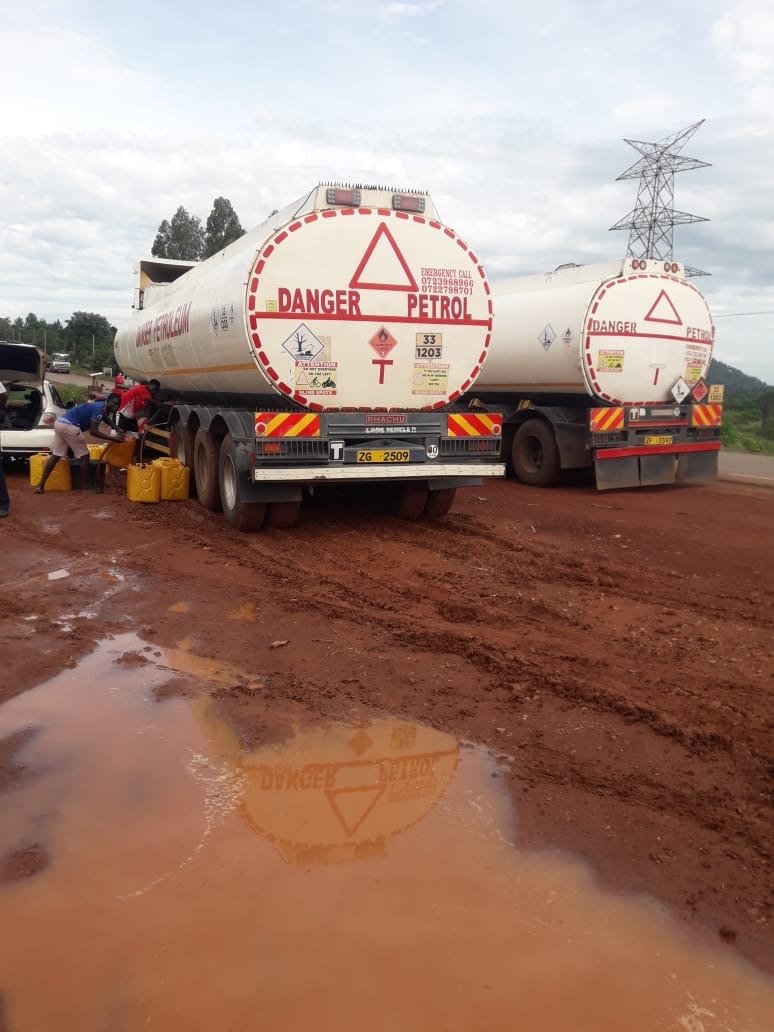
At 2:17 a.m. on a moonless night in April, a Toyota Premio idles beside a fuel tanker on the Iganga–Jinja highway. Two men work quickly. A pipe snakes from the tanker’s valve into a row of yellow 20-litre jerrycans. In 12 minutes, 400 litres of diesel are gone. The driver folds UGX500,000 into his pocket. The Premio vanishes toward Mbiko.
Multiply that transaction by dozens each night, across Busia, Malaba, and Mutukula. Add tankers whose cargo is replaced with water. Add fuel smuggled from Kenya and sold at shack-stations for UGX300 below pump price.
The total: Uganda loses an estimated UGX200 billion to UGX300 billion annually to fuel dumping, smuggling, and siphoning, according to preliminary Uganda Revenue Authority assessments. That is the cost of 100 new Health Centre IIIs. Or 15,000 teachers’ annual salaries.
For four years, one case file has mapped how the money disappears. Kabi CRB 22/2023 began with a single truck and a beeping weighbridge.
On 23 December 2022, truck Reg No. KCS 014K / ZE936 rolled onto a factory weighbridge in Kampala. It had left Mombasa days earlier with documents declaring 28,240kg of Olein Oil for a major manufacturer.
The weighbridge flashed an anomaly: 1,180kg excess weight.
During sampling, driver Amos Kafuko asked to step away. He did not return. When inspectors opened the middle of three compartments, water gushed out. The compartment was sealed and pressurized. After draining, only 18,090kg of Olein Oil was recovered. 10,330kg — worth roughly UGX309 million at current factory gate prices — had vanished.
Police impounded the truck. Six Kyoga Hauliers staff were arrested: four from Raw Material Handling, one from Quality Control, and one security officer. All were later released on police bond pending investigation.
The truck sat in the yard. The file went cold. Until January 2026.
On a Tuesday morning in January 2026, immigration officers at Entebbe Airport detained Amos Kafuko as he attempted to board a flight. He was handed to CID.
In a statement to police, Kafuko confessed. He described a network that had operated for years along the Northern Corridor.
He reportedly told detectives he was recruited by former Kyoga drivers Zishan Khalifan and Fadhil. The method was consistent: divert the truck to a private yard, siphon the product, then refill the compartment with water to match the expected weight within a margin that avoids instant red flags.
Kafuko further named individuals that facilitated the scheme at the factory. They included Mukwano Industries staff Bamwete Moses, Kenneth, Salim Isiko, and Wandera Stephen. He also named buyers, among them *Ssentongo of Mbiko.
Inside Musita: Pumps, Pipes, and Jerrycans
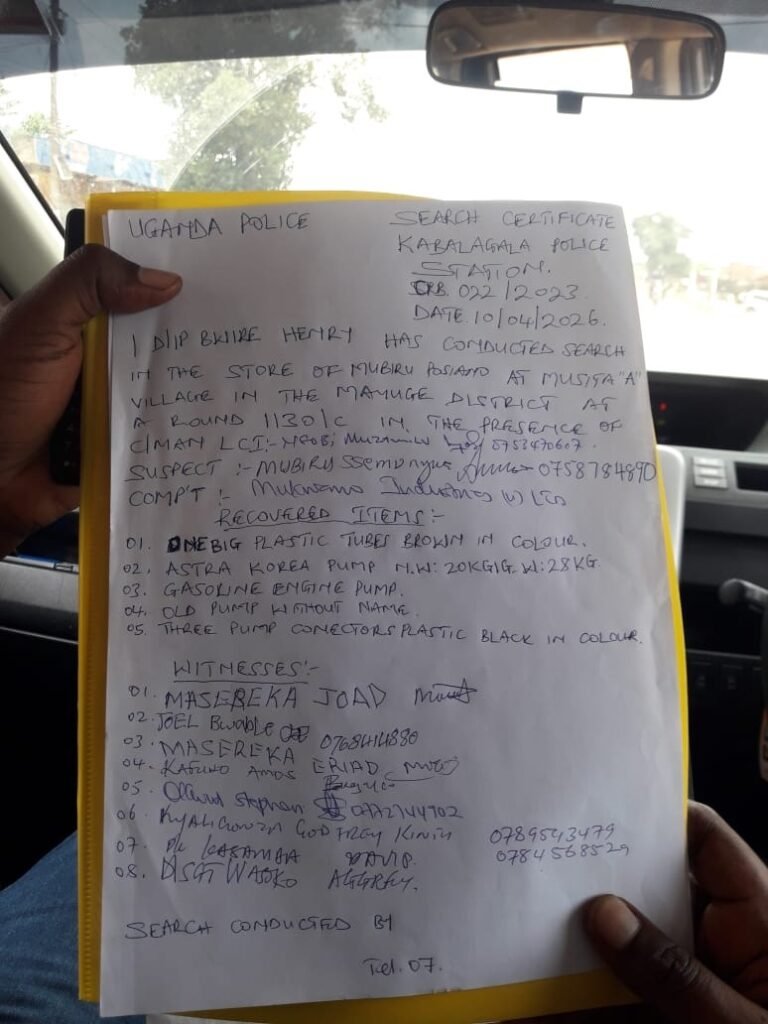
Armed with Kafuko’s information, officers from Kabalagala Police Station led by D/IP Wandera raided a yard at Musita on 12 April 2026.
Kafuko had allegedly identified the site as the location where his truck was offloaded and refilled with water in 2022.
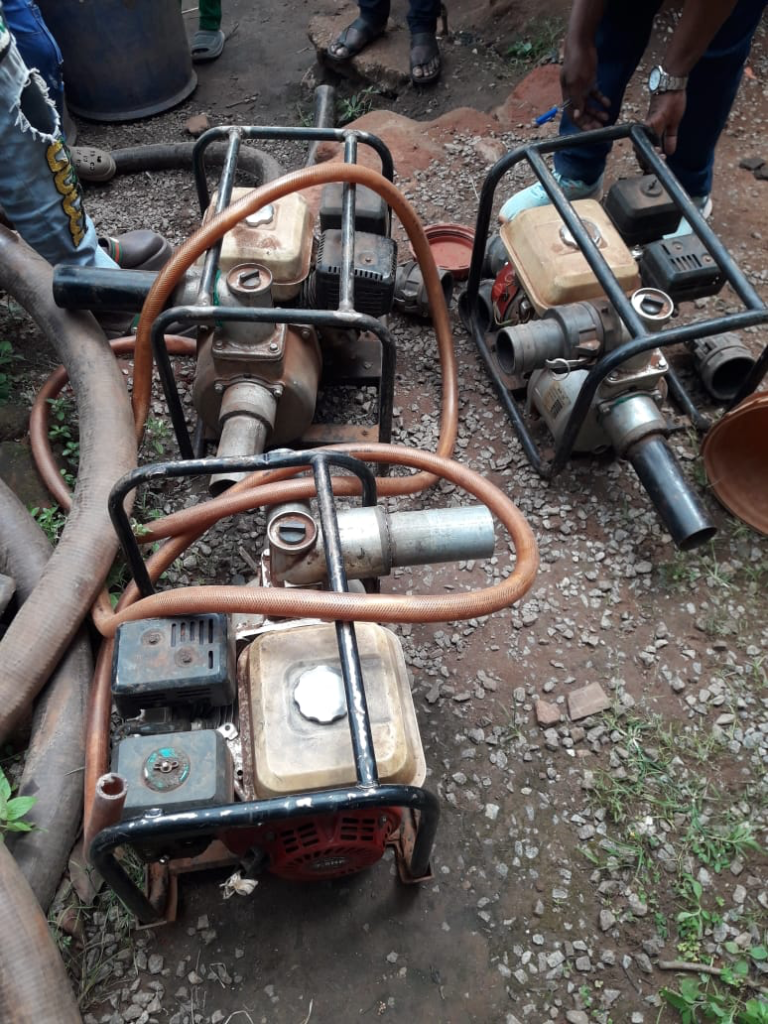
Police arrested the yard caretaker, Mubiru. Inside a locked store, they recovered three motorized pumps, rolls of industrial piping, and dozens of empty containers. The yard is said to belong to John Bamwira. Investigators say it was hired by individuals identified as Bakyala and Yahaya.
The real-time picture of the theft economy emerged just outside the yard. Along the Iganga–Jinja highway, police found two fuel tankers marked for delivery to Vivo Energy in Kampala. Officers reported that diesel was being actively siphoned from one tanker into jerrycans. The jerrycans were loaded into a saloon car.
The GPS Ghost: How ‘Creaser’ Fooled the System
The most sophisticated element emerged five days later. On 17 April 2026, police arrested Fazil / Fadhil in an operation near Kakiri, Wakiso District. In his statement, Fadhil allegedly explained how the syndicate beat modern tracking.
A technician known only as “Creaser” would be called to a diverted truck. Creaser would remove the GPS tracker and battery unit. He would then place the device in Fadhil’s personal car.
Fadhil would drive the Malaba–Kampala route at normal truck speed. To the transport company’s monitoring system, the truck appeared to be moving as scheduled. In reality, it was parked in a yard being drained.
Fadhil also named other Kyoga drivers he said were part of the ring, led by a man identified as Ramu. He reiterated the involvement of buyer Ssentongo of Mbiko.
The Economics of a Jerrycan
The Ministry of Energy and Mineral Development puts the tax component of a litre of diesel at roughly UGX1,500. That includes excise duty, VAT, and infrastructure levy.
Each 20-litre jerrycan siphoned off the books therefore denies the treasury UGX30,000. A single tanker diverted for 2,000 litres costs the state UGX3 million.
Transport industry sources estimate that at least 40 tankers are compromised nightly across the Busia, Malaba, and Mutukula routes. That is UGX120 million lost per night, or UGX43.8 billion per year, before counting smuggled fuel that never enters the customs system.
When adulterated fuel reaches pumps, engines fail. The Uganda National Bureau of Standards impounded 117 fuel stations in 2025 for selling substandard product. Most were in eastern Uganda.
On 21 April 2026, police produced five suspects before Makindye Chief Magistrates Court: Salim Isiko, Ssentongo, Fazil/Fadhil, Zishan Khalifan, and Mubiru.
Kafuko was arraigned earlier and released on bail until 5 May 2026. The prosecution’s first witness, identified as Kajja, has testified.
URA speaks
URA Commissioner General’s office told this publication that a new Digital Fuel Marking and Monitoring System will be rolled out by September 2026 to chemically tag all imported fuel.
“Any product without the marker will be presumed dumped or smuggled,” a senior official said.
The Ministry of Energy is piloting dual-tracking systems that combine GPS with fuel level sensors and tamper alerts. Transporters will be required to install them by December 2026.
Kyoga Hauliers declined to comment, citing ongoing court proceedings. Mukwano Industries had not responded by press time.
Back on Iganga road, the tankers still roll at night. The jerrycans still wait.
The Musita case file proved what customs officials have warned for years: Uganda’s fuel loss is not petty theft. It is organized, technical, and embedded.
The difference now is that Kabi CRB 22/2023 put names, yards, and methods in the public record.
Whether the convictions follow will determine if UGX300 billion stays on the road or returns to the treasury.