

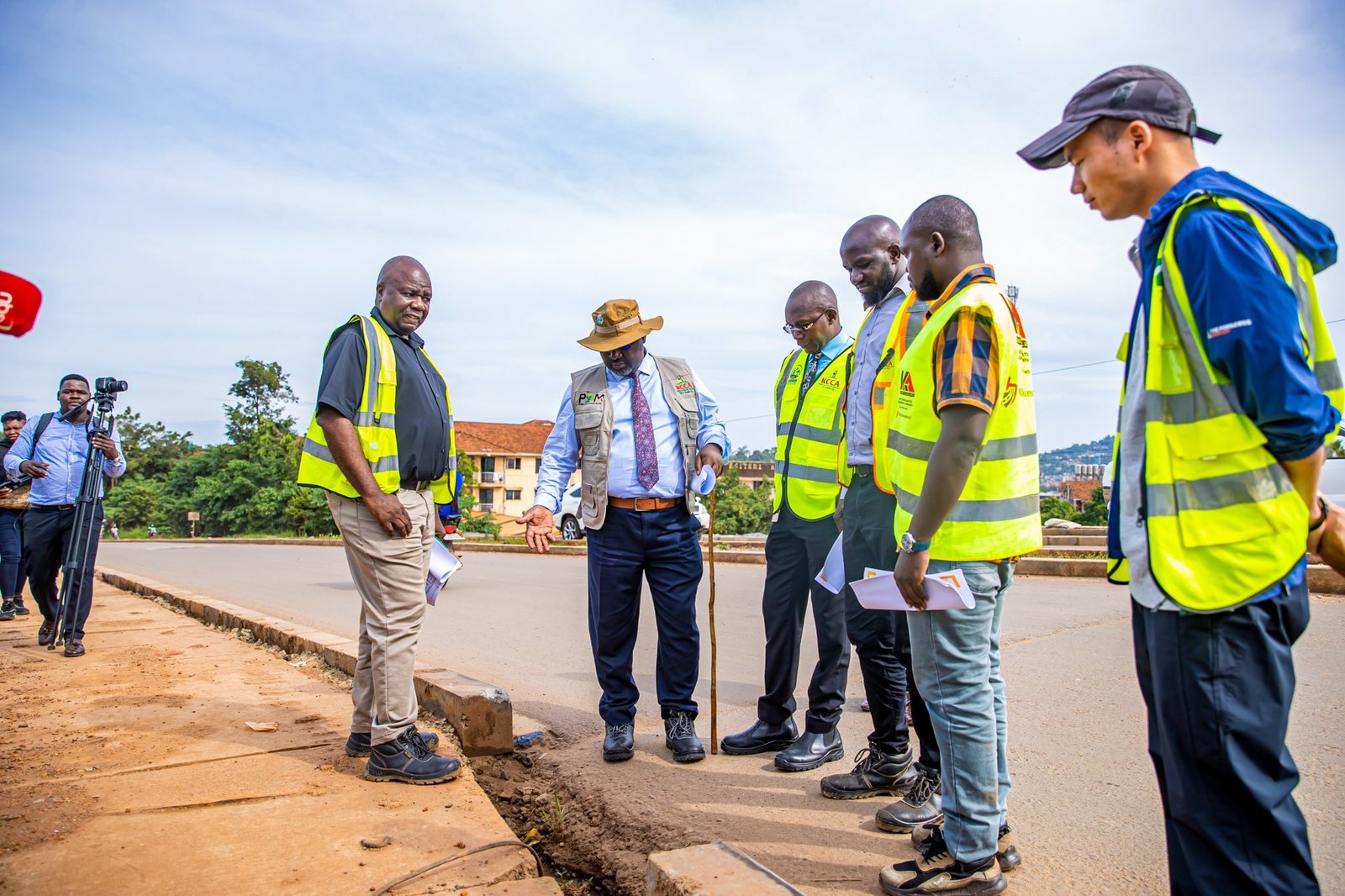
A no-nonsense inspection by Kampala Capital City Authority (KCCA) Deputy Executive Director Benon Kigenyi has exposed glaring safety lapses and forced immediate action on sections of the multi-billion Kampala City Roads Rehabilitation Project (KCRRP), as the authority tightens its grip on contractors and utility companies accused of cutting corners.
During a tense Wednesday afternoon tour, Kigenyi halted works at multiple sites, ordering contractors to seal dangerous open manholes on the spot — a move that underscored growing concern within Kampala Capital City Authority over what insiders describe as “unacceptable negligence” on critical infrastructure projects.
At both Nakawa near the railway crossing and in Luzira along Port Bell Road, construction teams were caught with exposed inspection chambers — hazards that could easily result in serious injury or death.
Kigenyi refused to proceed until the risks were eliminated, forcing contractors to scramble for materials and fix the problem immediately.
“Safety is not negotiable,” he declared, in remarks that signal a tougher enforcement stance as the project progresses.
But the crackdown didn’t stop there.
In a directive likely to ruffle feathers among telecom and utility providers, Kigenyi ordered an end to the widespread practice of stringing cables on roadside poles — a hallmark of Kampala’s chaotic urban landscape. Instead, all utility lines must be relocated into underground ducts already installed along the upgraded roads.
“All utility lines must go underground. The ducts are there, and they are free,” he said, warning that the era of cluttered poles and dangling wires is being phased out to restore order and improve public safety.
The directive places pressure on service providers to comply or risk being sidelined in one of the city’s most ambitious road upgrade programmes.
Kigenyi also flagged blocked drainage channels as a ticking time bomb for flooding and premature road damage, ordering contractors to urgently clear silt-clogged systems.
Poor drainage has long been blamed for the rapid deterioration of Kampala’s roads, raising questions about whether contractors have been prioritizing speed over durability.
The KCRRP — backed by the African Development Bank — covers more than 30 roads across the capital, including Port Bell Road, Old Port Bell Road, Spring Road, and Sentema Road.
While progress is visible, with asphalt laying underway in Kitintale and landscaping ongoing in several areas, Kigenyi’s intervention highlights deeper concerns about execution standards.
His insistence on constant supervision and coordination between KCCA engineers and contractors suggests that without tight oversight, costly mistakes could undermine the project’s long-term impact.
For a city desperate for durable infrastructure, the message from KCCA is clear: deliver quality work — or be called out in real time.