

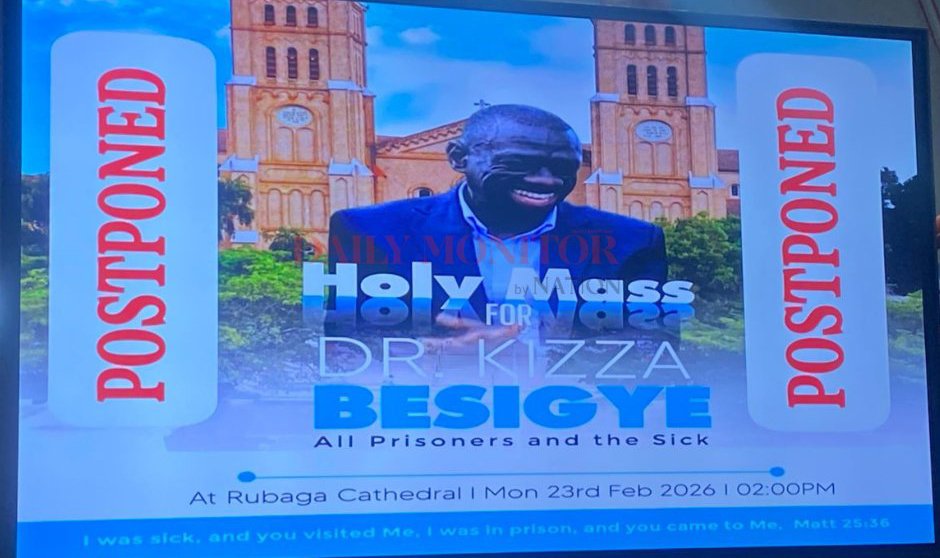
Confusion unfolded at Rubaga Cathedral on Monday afternoon after the Catholic Church abruptly postponed a special Mass that had been organised to pray for detained opposition figure Kizza Besigye and other political prisoners.
Despite the church announcing the postponement, several attendees who had already arrived proceeded to enter the cathedral and remained inside, stranded and without guidance from church officials. The reason for the sudden cancellation remained unclear by press time.
Friends and family members of Dr Besigye, alongside political figures from different parties, had gathered at the cathedral for the 2pm prayers. The Mass was expected to be led by Archbishop Paul Ssemogerere and was described by organisers as an interfaith moment of reflection on what they termed injustice against political detainees.
Byanyima Rallies Supporters
Earlier in the day, Eng Winnie Byanyima had called on Ugandans — particularly women — to turn up in large numbers to pray for her husband, who has been held at Luzira Prison for the past 15 months.
Dr Besigye, a four-time presidential candidate and long-time critic of President Yoweri Museveni, has been in detention since November 2024 on treason-related charges.
Byanyima, who alongside Besigye participated in the five-year guerrilla war that brought Museveni’s government to power in 1986, used the planned prayer gathering to reflect on what she described as shrinking civic and political space in Uganda.
“If women want to have an independent voice or want to speak freely and be critical, they are gagged lest they be punished,” she said ahead of the prayers. She added that many of the gains made during the early years of the National Resistance Movement, particularly around women’s participation in governance, had been eroded.
She cited examples of women who served during and after the bush war, saying the period was marked by deliberate efforts to bring women into combat, non-combat roles, and legislative positions.
“The Mass is meant to draw everyone regardless of religious denomination or party affiliation,” Byanyima said. “If you care about human rights and about these prisoners, come and pray with us.”
Health Concerns and Bail Denials
Byanyima expressed deep concern about her husband’s health, describing his condition as deteriorating due to what she called unhealthy prison conditions.
“He is continuously coughing, and the coughing saps his energy and he loses his voice,” she said, adding that he had developed an allergic reaction. Dr Besigye, who turns 70 in April, has reportedly been denied bail four times over the past year.
She questioned why authorities had continued to detain him despite his history of appearing in court over the past two decades on various charges. “Over the past 25 years, he has been in and out of court and has never run away,” she said.
Arrest and Legal Battle
Dr Besigye and his long-time ally Hajj Obeid Lutale were arrested on November 16, 2024, in Nairobi, Kenya, where they had travelled to attend the launch of a book by Kenyan opposition politician Martha Karua.
Four days later, they reappeared in Uganda and were arraigned before the General Court Martial in Makindye, charged with illegal possession of firearms and allegedly seeking to procure weapons from foreign countries including Switzerland and Greece. They denied the charges and were remanded to Luzira Prison, where they have remained.
Their continued detention has unfolded against the backdrop of a landmark ruling by the Supreme Court of Uganda on January 31, 2025, which held that military courts lack jurisdiction to try civilians. The court ordered that all ongoing military trials of civilians be halted and their files transferred to civilian courts, following a petition by former Nakawa MP Michael Kabaziguruka.
While the ruling stopped short of nullifying past convictions by military courts, it intensified scrutiny over the prosecution of civilians in such forums — a matter directly affecting Besigye’s case.
Growing Tensions
Byanyima also criticised recent public statements by Muhoozi Kainerugaba, the Chief of Defence Forces, accusing him of using inflammatory language against opposition figures. She described what she called a growing normalisation of abductions, detention and intimidation of government critics.
As uncertainty lingered over the postponed Mass, supporters inside Rubaga Cathedral waited for direction, underscoring the tense political climate surrounding one of Uganda’s most prominent opposition leaders.
Church authorities had not issued a detailed explanation for the postponement by the time of publication.