
Internal investigation questions millions spent through fuel cards, finds staff receiving fuel regardless of vehicle ownership and exposes glaring gaps in financial controls as Executive Director admits transactions are under investigation.
An internal audit at the Uganda Free Zones and Export Promotions Authority (UFZEPA) has raised serious questions over the management of public funds after uncovering questionable fuel transactions exceeding Shs348 million, multiple fuel withdrawals and glaring weaknesses in financial accountability systems.
A confidential internal audit report dated September 14, 2026, details how eight selected fuel cards were loaded with more than Shs348 million over a 12-month period, with investigators questioning large transactions involving multiple invoices at selected fuel stations.
The investigation, ordered by the Authority’s Board on July 24, 2026, followed concerns about fuel management, office imprest and allegations of missing money.
But what investigators uncovered went beyond questionable fuel purchases.
The report established that UFZEPA was operating without an approved fleet management policy and a Finance and Accounting Manual, leaving significant gaps in the systems meant to safeguard public resources.
Internal Audit Manager Peter Omwine warned the Board that the Authority’s financial management arrangements exposed public money to potential abuse.
“The findings indicate that in all circumstances, there are inadequate internal control systems in place,” Omwine wrote.
SHS348M LOADED ON FUEL CARDS
The audit examined selected fuel cards and established that six cards registered under Sharon Keitetsi Nangiro had received a combined Shs272.37 million.
Another card associated with Deo Kyomya was allocated Shs75.9 million, while a separate card held by accountant Fiona Kesiime received Shs12.3 million.
The allocations raise questions about the management and accountability of fuel distributed through the Authority’s card system.
More concerning, investigators established that UFZEPA staff received quarterly fuel allocations regardless of whether they owned vehicles.
“It has also been established that staff are given quarterly fuel loaded on their cards whether one owns a car or not and such fuel may be used in form of transport,” the report states.
The arrangement raises questions about the criteria used to distribute public fuel, the justification for individual allocations and the mechanisms available to establish whether the fuel was used for authorised official purposes.
MULTIPLE FUEL WITHDRAWALS RAISE RED FLAGS
The investigation separately examined Shs61.64 million in selected fuel transactions, identifying several substantial purchases supported by unusually high numbers of invoices.
On July 15, 2025, an Administration 2 fuel card recorded purchases worth Shs7.75 million at Shell Kawempe, generating 14 separate invoices.
A day earlier, an Administration 1 card recorded transactions worth Shs7.25 million at Shell Lugogo, supported by 16 invoices.
Other transactions included Shs4.77 million at Shell City Square in January 2026 and Shs3.5 million at Shell Kawempe in March 2026.
The auditors questioned the repeated transactions, warning that weak controls over fuel withdrawals could create opportunities for abuse.
“It cannot be ruled out that such fuel would be drawn as cash and misused which is irregular and is punishable,” the report states.
However, the investigation did not establish that the fuel was actually converted into cash or that any particular officer had stolen the money.
Instead, the auditors flagged the transactions as requiring stronger verification and accountability.
GENERATORS EXPLANATION FAILS TO CONVINCE AUDITORS
UFZEPA management disputed the suggestion that multiple fuel transactions necessarily indicated irregularities, explaining that the purchases were intended to supply generators and a reserve fuel tank at the Entebbe International Airport Free Zone.
According to management, the facility has two generators, each with a capacity of 691 litres, and a reserve tank capable of holding 5,000 litres.
Management explained that the Authority lacked infrastructure for direct bulk fuel deliveries because the tanks had small nozzles and lacked appropriate valves.
Consequently, fuel was transported using jerrycans.
The explanation was that filling station attendants repeatedly stopped dispensing whenever individual jerrycans became full, resulting in multiple transactions and invoices.
Management maintained that the purchases were supported by receipts, fuel logs and security records.
“Management too clarifies that the occurrence of multiple fuel transactions on the same day does not constitute fuel misuse or irregularity,” the official response states.
But the explanation did little to settle the auditors’ concerns.
“The explanation that Multiple fuel withdrawals were meant for generators remains questionable,” the report concludes.
The disagreement leaves a critical accountability question: whether the Authority can independently demonstrate that all the fuel purchased was actually delivered to the Entebbe facility and consumed for its intended purpose.
UFZEPA EXECUTIVE DIRECTOR ADMITS CONTROL WEAKNESSES
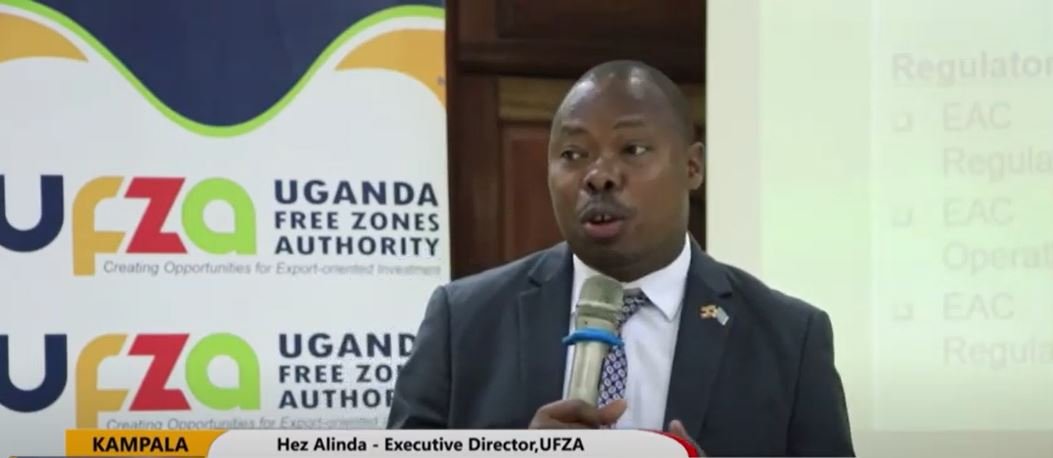
Contacted by ChimpReports, UFZEPA Executive Director Hez Kimoomi Alinda acknowledged the weaknesses identified by the internal investigation but insisted that the Authority was taking steps to address them.
Alinda said the Authority was only 18 months old and took financial accountability, governance and proper management of public resources seriously.
“The 18 months old Authority takes matters of financial accountability, governance and proper management of public resources seriously,” he said.
He confirmed that the disputed fuel transactions were still being investigated.
“The transactions in question are a subject of an inquiry. They arose from feeding the generators and tank reservoir at Entebbe using jerrycans because the nozzles of the tank are small and lacked a valve for bulk delivery,” Alinda explained.
He said UFZEPA had engaged its fuel supplier and contractor to modify the tanks to allow direct bulk deliveries and eliminate the need to transport fuel in jerrycans.
The Executive Director also disclosed that a draft Fuel and Fleet Management Policy had been submitted to management, while a draft Finance and Accounting Manual was awaiting approval by the Board.
Alinda added that the Senior Administrative Officer was responsible for fleet management and, by implication, fuel management.
Management has pledged to review questionable transactions and hold responsible officers accountable where irregularities are established.
FUEL MANAGEMENT SCANDALS HAUNT PUBLIC INSTITUTIONS
The UFZEPA findings come against the background of several high-profile fuel-related financial scandals involving Ugandan public institutions.
During the 2012 Office of the Prime Minister corruption scandal, investigators questioned Shs6.8 billion in fuel payments, including Shs576 million reportedly spent within just four days.
The investigations uncovered allegations involving forged signatures, fictitious supplies and questionable receipts.
In 2015, investigations into the Uganda National Roads Authority (UNRA) exposed suspected fraudulent fuel-card transactions, including records indicating that the same fuel card had allegedly been used in Kampala and Gulu within five minutes.
In 2023, Parliament investigated approximately Shs357 million in suspected fraudulent fuel withdrawals at the Ministry of Trade, where officials were accused of manipulating fuel cards.
The concerns resurfaced in May 2025 when Busia Municipal Council officials and fuel station employees were charged over the alleged diversion of more than Shs200 million through fictitious fuel transactions.
Although these cases involved different institutions and circumstances, they highlighted recurring vulnerabilities in public fuel management, particularly weak reconciliation systems, questionable invoices and inadequate monitoring of fuel-card transactions.
The latest findings at UFZEPA have once again brought these accountability concerns into focus.
AUDIT DEMANDS ACCOUNTABILITY
The internal auditors recommended corrective action against officers found responsible for fuel mismanagement and called for the introduction of a formal fleet management policy.
However, several questions remain unanswered.
Why were six fuel cards registered under one individual custodian? What criteria determined the quarterly fuel allocations to staff who did not own vehicles? Were all the fuel purchases supported by independently verifiable delivery records? And can management account for every litre purchased using public funds?
The absence of an approved Finance and Accounting Manual also raises broader questions about the financial governance arrangements at an Authority entrusted with managing Uganda’s free zones and promoting export development.
While management insists that the disputed fuel was used to power generators at Entebbe, the auditors have maintained that the explanation requires further scrutiny.
The ongoing inquiry will therefore be crucial in establishing whether the questionable transactions were simply a consequence of inadequate fuel-handling infrastructure or whether individual officers exploited weaknesses in the Authority’s financial controls.
For now, the Shs348 million fuel-card allocations and the transactions flagged by investigators leave UFZEPA management facing a major accountability test.