
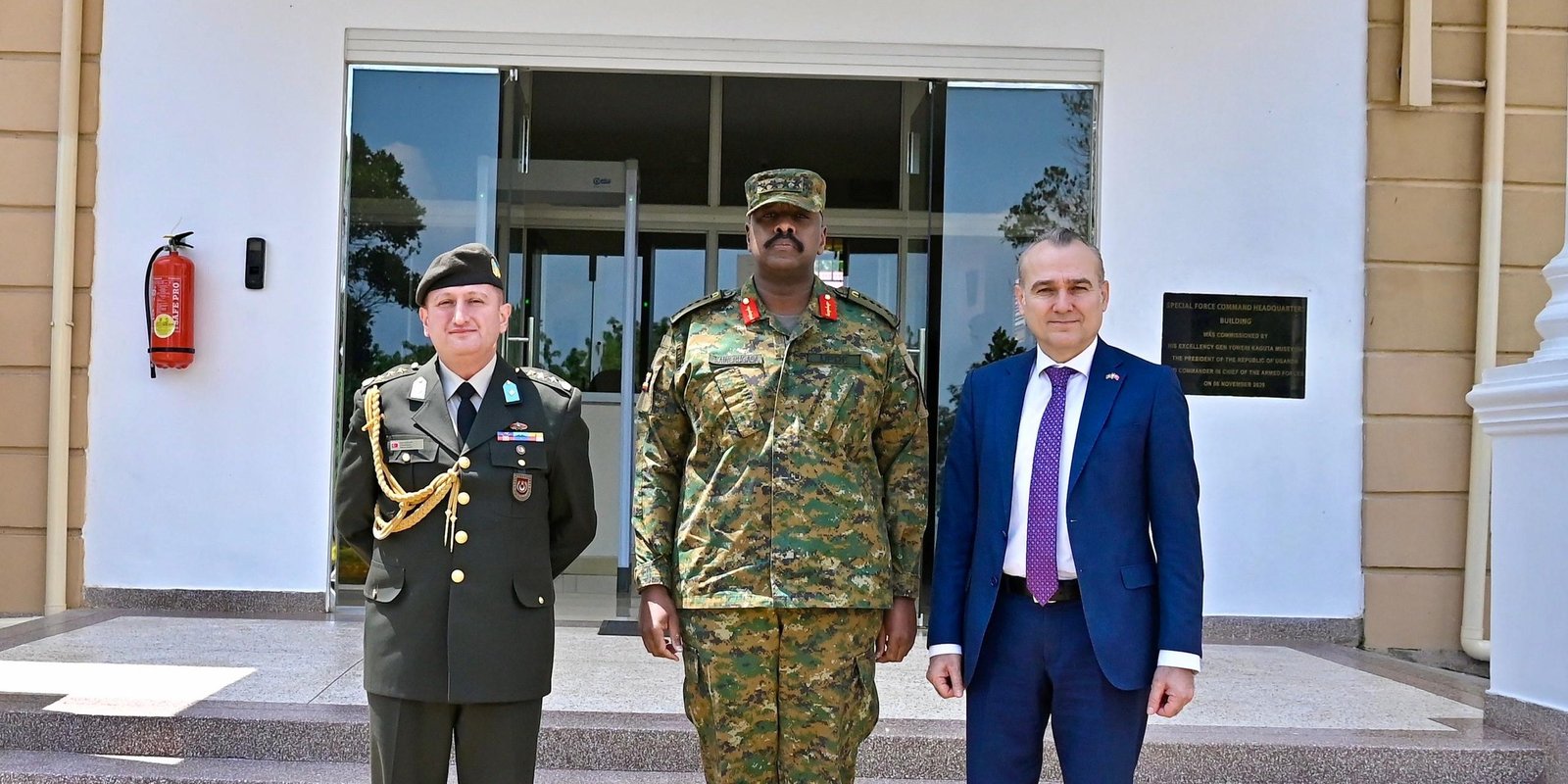
Uganda has suspended all defence and military cooperation with Türkiye, dramatically escalating a months-long diplomatic and political confrontation that has increasingly drawn in Chief of Defence Forces Gen Muhoozi Kainerugaba.
The Uganda People’s Defence Forces (UPDF) announced the decision on Saturday, September 19, 2026, saying the suspension takes immediate effect and will remain in place until outstanding issues concerning defence and military cooperation between Uganda and Türkiye are resolved.
“The Uganda People’s Defence Forces (UPDF) has with immediate effect suspended all and any Defence and Military cooperation with the Republic of Türkiye,” said Col Chris Magezi, Acting Director of Defence Public Information at the Ministry of Defence and Veteran Affairs/UPDF.
The statement did not specify the individual defence agreements, programmes or outstanding disputes covered by the suspension.
The move comes a day after hundreds of supporters of the Patriotic League of Uganda (PLU) marched to the Turkish Embassy in Kampala demanding that Türkiye hand over Ugandan political dissident Fred Lumbuye, who has been based in Türkiye.
The demonstration was organised by PLU Secretary General Fadil Twalla following a directive from Gen Muhoozi, who chairs the organisation. The protesters accused Türkiye of allowing Lumbuye to use its territory to attack Uganda’s leadership.
The Turkish Embassy had announced that it would close on September 18 because of the planned demonstration.
MUHOOZI’S ESCALATING TURKEY SHOWDOWN
The latest UPDF decision caps months of increasingly public confrontation between Gen Muhoozi and Turkish authorities.
In September, the CDF ordered Turkish nationals to leave Uganda and announced plans for a major demonstration outside the Turkish Embassy.
He said he had severed ties with Turkish interests in Uganda, although reports noted that the directive was made through his social-media accounts and was subsequently deleted. Uganda’s Foreign Ministry did not publicly reiterate the expulsion order as an official government policy at the time.
The immediate flashpoint has been Lumbuye, whose political commentary from Türkiye has continued to attract significant attention among Ugandan audiences.
Ugandan authorities accuse Lumbuye of offences including harmful propaganda, incitement and cybercrimes. The protesters on Friday demanded that Ankara facilitate his return to Uganda to face the allegations. Lumbuye’s side has not been able to respond to the latest claims in the reports reviewed.
But the dispute extends beyond Lumbuye.
$1 BILLION DEMAND AND THREAT TO CLOSE EMBASSY
Earlier in 2026, Gen Muhoozi publicly threatened a much wider rupture with Türkiye.
In April, he demanded $1 billion from Türkiye, describing the payment in the context of Uganda’s military contribution to regional security, particularly Somalia. He also threatened to sever diplomatic relations and close the Turkish Embassy in Kampala if his demands were not met.
The comments triggered international attention and further complicated an already sensitive relationship.
Uganda has for years deployed troops in Somalia as part of international and African efforts to support the Somali government against militant groups. Türkiye, meanwhile, has expanded its political, economic and security influence in Somalia, creating another layer to the competing interests surrounding Kampala and Ankara.
SGR DEAL ADDS FUEL TO THE DISPUTE
The confrontation intensified again in June when Gen Muhoozi announced that Uganda had cancelled the approximately $3 billion contract awarded to Turkish construction company Yapı Merkezi for the Malaba-Kampala Standard Gauge Railway.
The contract, signed in October 2024, covered the 272-kilometre Malaba-Kampala section of the SGR. President Yoweri Museveni officially launched construction in November 2024.
Muhoozi said Uganda would seek another contractor and subsequently backed calls for PLU supporters to demonstrate at the Turkish Embassy.
The SGR controversy added an economic and infrastructure dimension to what had initially been dominated by diplomatic and security complaints.
FROM DEFENCE PARTNERS TO MILITARY SUSPENSION
The decision announced Saturday is particularly significant because Uganda and Türkiye had previously developed formal defence-industry cooperation.
The UPDF said in December 2024 that the two countries were deepening defence ties following the fourth Uganda-Türkiye Defence Industries Cooperation meeting in Kampala.
The cooperation was based on a defence-industries agreement signed in 2016, with discussions covering defence technology and industrial collaboration.
The UPDF described the arrangement as an important strategic partnership and noted that the agreement had been signed in the presence of President Museveni and Turkish President Recep Tayyip Erdoğan during Erdoğan’s 2016 visit to Uganda.
Türkiye’s official foreign ministry records say diplomatic relations with Uganda date back to 1969, while the Turkish Embassy in Kampala began operations in 2010 and its current chancery became operational in 2018.
The Turkish Embassy also maintains a military attaché’s office in Kampala, underlining the depth of the defence relationship now affected by the UPDF suspension.
WHAT THE SUSPENSION MEANS
The UPDF statement does not say that Uganda has severed diplomatic relations with Türkiye.
Instead, it specifically targets defence and military cooperation, while leaving the door open for a resolution of what the army calls “outstanding issues of mutual defence and military cooperation.”
That distinction is important because diplomatic relations between the two countries formally remain in place.
The Turkish Embassy remains Uganda’s official diplomatic mission, while Türkiye also maintains an embassy in Ankara accredited to Uganda.
The latest development therefore represents a major deterioration in military relations without, at this stage, amounting to a formal diplomatic break.
For now, the central question is what Ankara and Kampala consider the “outstanding issues” referred to by the UPDF and whether the suspension will remain limited to military cooperation or trigger further action across the wider Uganda-Türkiye relationship.
The UPDF has not given a timeline for resolving the dispute.