
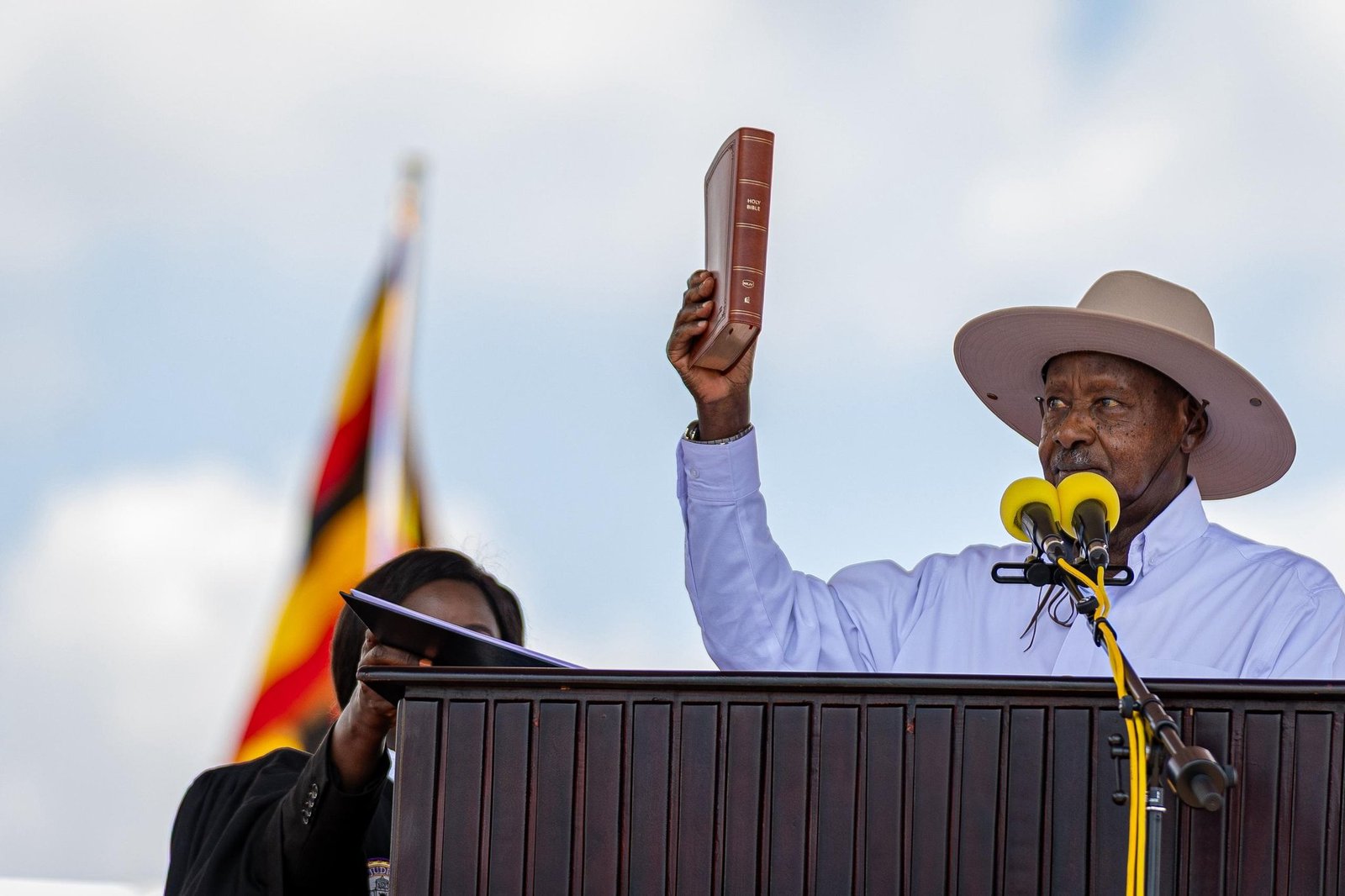
At a colorful swearing-in ceremony held at the Kololo Ceremonial Grounds on Tuesday, President Yoweri Kaguta Museveni used his inaugural address to declare the beginning of what he described as a new era of hard work, wealth creation, industrialization and economic transformation for Uganda.
The veteran leader, who was sworn in for another term after the 2026 general elections, delivered a lengthy and ideological speech that centered on economic productivity, job creation, value addition, regional integration, environmental conservation and the role of citizens in fighting poverty.
Addressing visiting Heads of State, government officials, diplomats, religious leaders and thousands of Ugandans gathered at Kololo, Museveni congratulated Ugandans for what he called successful elections and praised the ruling National Resistance Movement (NRM) for securing overwhelming victories across the country.
He also applauded opposition parties such as the Democratic Party (DP) and Uganda People’s Congress (UPC) for participating peacefully in the electoral process, while criticizing the National Unity Platform (NUP) and some elements within the Forum for Democratic Change (FDC), whom he accused of using violence during campaigns.
“The parties under IPOD should clearly lay out agreed guidelines on the dos and don’ts of election management according to the laws and Constitution of Uganda,” Museveni said.
However, the central theme of Museveni’s speech was economic awakening, which he repeatedly summarized using the phrase: “No More Sleep.”
“This Kisanja should be regarded as a Kisanja of no more sleep for all Ugandans,” the President declared as he challenged citizens to take advantage of government programs and opportunities to create wealth and jobs.
Museveni argued that since the NRM took power in 1986, Uganda has undergone tremendous transformation in peace, infrastructure and economic growth, and that citizens must now focus on productivity rather than dependency.
He pointed to the massive expansion of real estate around Kampala and Entebbe as evidence of the country’s economic growth over the last four decades. The speech was accompanied by visual presentations showing aerial photographs of Kampala in 1986 compared to modern developments in areas such as Akright City, Bwebajja and Nakasero.
The President outlined what he described as the “matafaari” or building blocks the NRM government has laid for Uganda’s transformation. These included peace and security, infrastructure development, social services, wealth creation, market access and regional political integration.
Museveni credited Uganda’s peace to the NRM ideology, which he said rejected sectarian politics based on tribe or religion and instead emphasized the interests of wealth creators. He also highlighted the role of the Uganda People’s Defence Forces (UPDF) in maintaining national stability.
On infrastructure, the President cited investments in roads, electricity, piped water, railways, airports, telecommunications, schools and health centers as foundations for economic growth.
Museveni said Uganda’s economic future lies in four key sectors: commercial agriculture, manufacturing, services and Information Communication Technology (ICT). According to him, these sectors have the capacity to create millions of jobs for Ugandans if fully exploited.
“The issue now is wealth creation and jobs creation,” Museveni emphasized, adding that government had already created the enabling environment through programs such as the Parish Development Model (PDM), Emyooga, Operation Wealth Creation (OWC) and Uganda Development Bank financing.
The President showcased examples of successful Ugandan farmers and industrialists whom he said had transformed their lives through commercial agriculture and manufacturing. These included farmers such as Basangwa Johnson of Kamuli, Ijala Joseph of Serere and Nyakaana from Fort Portal, as well as industries operating in Mbale Industrial Park.
Museveni particularly highlighted Nyakaana’s farming model, claiming the farmer earns over Shs240 million annually from just 1.3 acres of land while employing 15 people. He argued that if millions of Ugandans adopted similar intensive farming methods, Uganda could generate more than 100 million jobs in small-scale agriculture alone.
The President also praised large-scale employers such as the Madhvani Group, which he said employs over 14,000 workers at Kakira Sugar Works, alongside hotels like Sheraton Kampala Hotel and Speke Resort Munyonyo for creating jobs in the hospitality sector.
Museveni criticized the growing trend of Ugandans seeking employment abroad, arguing that opportunities already exist within the country.
“It is a shame to see Ugandans going abroad to look for jobs; yet, as you can see, the jobs are easily available here, if you listen to our advice,” he said.
The President further said Uganda’s industrial and technological future would require more skilled labor, citing Ugandan engineers working at major infrastructure projects such as Karuma and Isimba hydropower dams and the vehicle manufacturing company Kiira Motors Corporation.
According to Museveni, Uganda has significantly increased the number of households participating in the money economy — from just 9.4 percent at independence in 1962 to 67 percent today due to government interventions like OWC and PDM.
He argued that if all Ugandan households entered the money economy, the country would eventually face labor shortages and need to import workers from neighboring African countries.
One of the strongest sections of Museveni’s speech focused on industrialization and value addition. He criticized African countries for exporting raw materials instead of processed products, describing it as a “strategic blunder” that has kept Africa poor decades after independence.
Using gold exports as an example, Museveni said Africa loses enormous wealth and employment opportunities by exporting unprocessed minerals.
“If the gold is processed to 99.90 percent purity, you get USD 168,000 instead of USD 60,000 for unprocessed gold,” he said, arguing that refining and manufacturing should happen within Africa.
The President defended Uganda’s policy banning the export of unprocessed minerals and called for greater vertical and horizontal integration of African economies. He argued that Africa’s economy should be worth at least USD 60 trillion given the continent’s population and natural resources.
Museveni also linked economic growth to consumer purchasing power, using his dairy business as an example. He said his goal was to ensure more Ugandans have money to buy locally produced milk and other products.
“I produce milk. I want many Ugandans and Africans to buy my milk. However, they cannot buy my milk unless they have money in their pockets,” he remarked.
The President also addressed agriculture and rural transformation, emphasizing irrigation, fish farming and household-level water access. He praised Ntungamo Woman MP Joselyn Kamateneti for developing a solar-powered village water system model that he said could improve livestock and agricultural productivity in rural areas.
Museveni pledged continued government support for fish farming, irrigation and mechanization under the Fourth National Development Plan (NDP-IV).
He also warned local leaders and SACCO managers against diverting funds meant for PDM and other government wealth creation programs, urging wananchi to actively monitor their Parish SACCOs and hold leaders accountable.
On environmental conservation, Museveni announced a renewed campaign to protect wetlands, forests and water catchment areas. He specifically ordered an end to rice and potato cultivation in wetlands, proposing fish farming as a more sustainable alternative.
“We need our wetlands for both our rain and irrigation,” Museveni said, adding that environmental destruction threatens Uganda’s rainfall patterns, indigenous medicine and river systems.
The President concluded by thanking African leaders and international guests who attended the ceremony and reaffirmed Uganda’s commitment to peace, regional cooperation and economic transformation.
“God Bless Africa. God bless Uganda. Let there be Peace and Justice in the World,” Museveni said as he officially began another term in office.