
Uganda’s water crisis in the Greater Kampala Metropolitan Area is increasingly being blamed not on a lack of treated water, but on a distribution network struggling to move available supplies to the communities that need them most.
The National Water and Sewerage Corporation (NWSC) has now turned to a major network expansion and rehabilitation project intended to close that gap, with Managing Director Eng. Dr Silver Mugisha warning contractors that Kampala’s rapidly growing population cannot afford further delays.
Known formally as the Rehabilitation, Restructuring, Rezoning and Extension of the Greater Kampala Metropolitan Area (GKMA) Water Supply Network Project, Package 2B, the project is designed to expand transmission capacity, build strategic reservoirs and booster stations, and reorganise the network so that treated water can reach underserved parts of the metropolitan area.
The project has a contract value of about €92.4 million, equivalent to roughly Shs340 billion, and is principally financed by the French Development Agency (AFD), with support from the European Union, the European Investment Bank and Germany’s KfW.
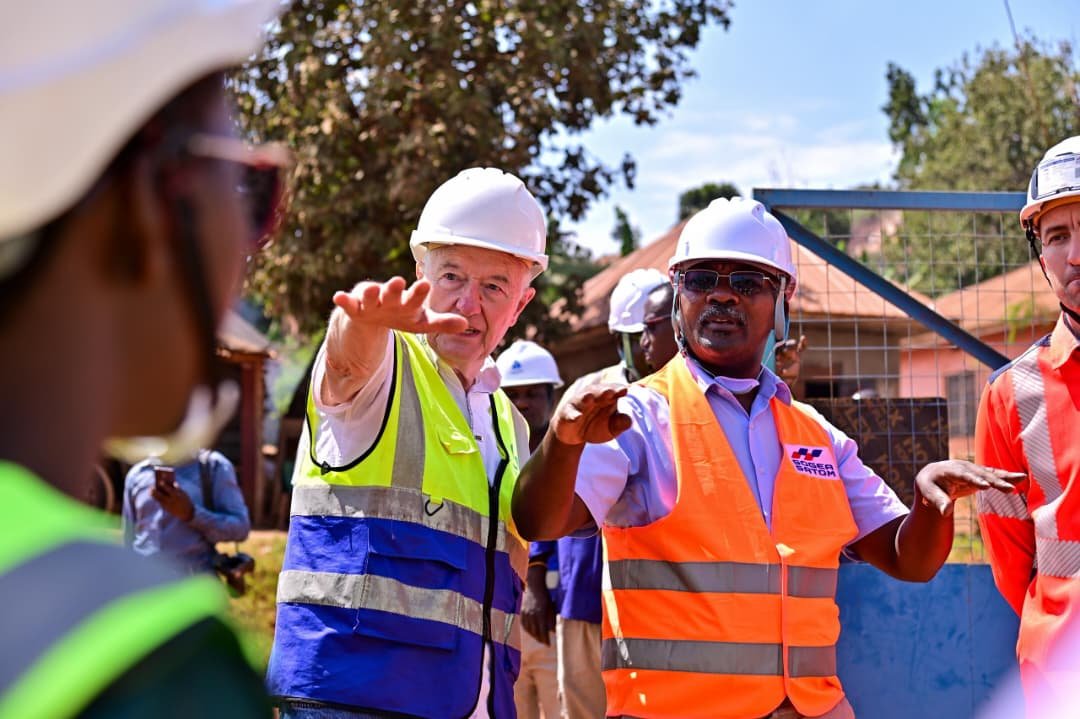
During an inspection of the ongoing works on Wednesday, Dr Mugisha said the intervention was critical because Greater Kampala’s water demand was rising every day while sections of the existing network remained unable to deliver sufficient quantities to consumers.
“The demand for water in the Greater Kampala Metropolitan Service Area is growing every day, and customers need answers. The project must be completed within time and budget,” Dr Mugisha said.
Katosi has water — the network cannot move it
At the centre of the project is a problem that exposes one of the biggest weaknesses in Kampala’s water infrastructure.
The Katosi Water Treatment Plant, which came online with an additional treatment capacity of 160 million litres of water per day, is currently operating at only about 52 percent of its capacity, according to NWSC.
The reason is not that Kampala does not need the water.
Rather, the existing distribution infrastructure cannot transport all the treated water from Katosi to consumers across the metropolitan area.
This has created the unusual situation in which a city experiencing recurrent shortages has substantial treatment capacity that cannot be fully utilised.
NWSC says Package 2B is intended to provide the missing distribution link.
Once completed, the project will enable the corporation to evacuate Katosi’s full current output of 160 million litres per day and distribute it to areas currently experiencing supply pressure.
Dr Mugisha said the corporation was deliberately shifting emphasis from simply increasing production to expanding the network capable of carrying water to consumers.
“We have a lot of water at Katosi, and plans are under way to evacuate more and serve Kampala,” he said.
He also directed NWSC engineers to begin work on an additional water-evacuation line from Katosi, which is designed to support the plant as its production capacity increases towards 240 million litres per day.
The additional supply, he said, would help reduce pressure on the older Ggaba water works, which have for years carried a significant portion of Kampala’s water-supply burden.
70 kilometres of pipelines
Package 2B is not a single construction site but a network-wide intervention covering several parts of Greater Kampala.
The project involves laying approximately 70 kilometres of transmission mains, constructing three reservoirs, building booster stations and upgrading the Kampala Water SCADA control system.
The reservoirs include:
- A 10-million-litre concrete tank at Kanyanya;
- A 3.89-million-litre steel tank at Kabulengwa; and
- A one-million-litre steel tank at Mutungo.
Two major booster stations are also being constructed at Kungu and Kabulengwa to improve pressure and enable water to reach elevated and previously underserved areas.
The project is being executed by Sogea Satom under the supervision of the ARTELIA–Gauff Association.
Project 35% complete
NWSC says the project, which commenced in February 2025, is currently about 35 percent complete.
Approximately 25 kilometres of the planned 70 kilometres of transmission mains have already been laid.
The Kungu booster station is reportedly the most advanced component, at about 70 percent completion, followed by the Kabulengwa booster station at 65 percent.
The Mutungo reservoir is about 55 percent complete, while pipe-laying has reached roughly one-third of the planned network.
Dr Mugisha, however, wants the pace increased.
During the inspection, he pressed the contractor to accelerate pipe-laying and ordered the contractor and supervising consultant to produce an acceleration plan and quarterly progress reports demonstrating tangible work on the ground.
He also pledged to personally inspect the project every quarter.
NWSC said the contractor and consultant had been instructed to work closely together to ensure that acceleration does not come at the expense of quality.
Residents will not have to wait until 2027
Although the entire Package 2B project is expected to be completed in 2027, NWSC says residents will begin seeing improvements before the final completion date.
The contractor is pursuing sectional handovers, allowing completed portions of the network to be commissioned while construction continues elsewhere.
One of the first major sections expected to come online is the Namugongo–Kasangati line, which is scheduled for commissioning by the end of 2026.
A 7.7-kilometre bulk pipeline running from Namugongo through Bulindo, Nsasa and Mulawa to the Kira–Kasangati road is expected to be ready from December 2026.
The line is expected to improve supply to Namugongo, Kira, Buwaate, Bulindo, Mulawa, Kasangati and surrounding communities.
Dr Mugisha welcomed the phased approach, saying NWSC should not wait for the entire project to be completed before switching on sections that are already ready to serve consumers.
The strategy is aimed at delivering immediate relief to communities suffering from unreliable supply while the broader infrastructure is still under construction.
Kampala’s population explosion raises the stakes
The urgency of the project is being driven by the explosive growth of the Greater Kampala area.
According to the 2024 National Population and Housing Census, Kampala and Wakiso districts together have a population of more than 5.2 million people.
Wakiso has emerged as Uganda’s most populous district, placing enormous pressure on roads, drainage, electricity, sanitation and water infrastructure.
Much of the urban expansion has occurred faster than the supporting infrastructure.
New residential estates and rapidly developing suburbs have mushroomed across areas such as Kira, Bulindo, Namugongo, Kasangati, Nansana, Wakiso, Gayaza, Matugga and Kawempe.
NWSC says the existing network in some of these areas is either ageing, unevenly distributed or simply too small to cope with current and projected demand.
Package 2B is therefore being designed not merely to solve today’s shortages, but to create capacity capable of supporting demand through 2040.
Engineers warned over leaks and bursts
NWSC Deputy Managing Director for Technical Services, Eng. Johnson Amayo, warned that speed must not compromise the integrity of the new network.
He directed the contractor to undertake adequate pressure testing of the newly installed pipelines to minimise the risk of leaks, bursts and other failures once the system is commissioned.
The emphasis on durability was echoed by project consultant David Gaunt, who said the infrastructure was being designed to last for more than five decades.
“We are looking at a project that will last over 50 years,” Gaunt said.
He commended Sogea Satom, the contractor, describing it as an internationally recognised company with experience in delivering durable infrastructure.
NWSC says it can maintain the network
NWSC officials also moved to address a potential challenge that often emerges after major infrastructure projects are completed — maintenance.
Alex Gisagara, NWSC Senior Director for Engineering Services, said the corporation had built sufficient internal technical capacity to operate and maintain the new infrastructure after handover.
He pointed to NWSC’s experience managing newer facilities, including the Katosi and Kagera water works.
“Our team is already handling the Katosi and Kagera water works, which are new. Once Katosi Package 2B is done, our team is ready to effectively manage and maintain the system,” Gisagara said.
NWSC Senior Director for Projects and Capital Development Eng. Paddy Twesigye reaffirmed the corporation’s commitment to improving reliability across its areas of operation.
A costly fix to an increasingly expensive problem
The Package 2B investment represents a major shift in the way Uganda is approaching the Greater Kampala water crisis.
For years, the focus has largely been on producing more water, including through major treatment infrastructure such as Katosi.
But the current situation demonstrates that production capacity alone cannot solve Kampala’s water shortages if the transmission and distribution network cannot carry the water to consumers.
Package 2B is therefore intended to unlock infrastructure that Uganda has already invested heavily in while simultaneously preparing the metropolitan network for future growth.
Once complete, the project will extend and strengthen supply across communities in Wakiso, Kakiri, Gayaza, Nansana, Kanyanya, Luteete and Matugga, among others.
For residents who have endured dry taps despite living in a metropolitan area with expanding water-treatment capacity, the test will ultimately be simple: whether water consistently reaches their homes.
NWSC now has until 2027 to prove that the billions being poured into the network can finally turn Kampala’s growing water demand into reliable supply.