
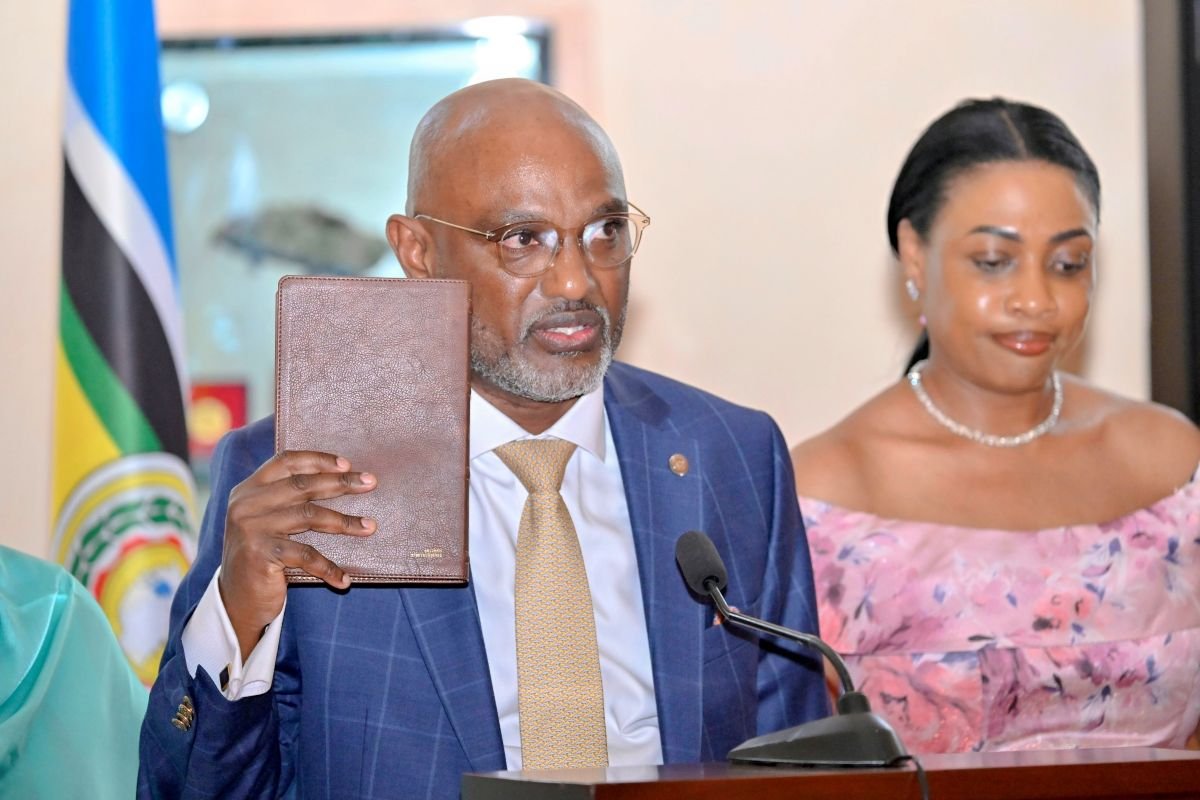
Ambassador Adonia Ayebare has finally taken the oath of office as Uganda’s Minister of Foreign Affairs, ending a nearly two-month wait that kept one of President Yoweri Museveni’s most prominent new Cabinet appointments in limbo.
Ayebare was among the ministers designated in Museveni’s new 2026–2031 Cabinet, announced on May 26, with the veteran diplomat selected to replace Gen. Jeje Odongo at Foreign Affairs.
His formal assumption of office, however, did not happen alongside the bulk of the new Cabinet.
The citizenship question that stopped Ayebare
When Museveni’s new Cabinet assembled at State House Entebbe for swearing-in on June 8, Ayebare was conspicuously absent.
He was one of four ministerial nominees whose oath-taking was halted while government agencies and lawyers examined questions surrounding their citizenship status. The other affected nominees were Calvin Echodu, Shartsi Kutesa Musherure and Dr Lawrence Muganga.
The issue was significant because Uganda’s law permits dual citizenship generally, but specifically bars people holding dual citizenship from occupying certain offices of State. The Fifth Schedule to the Uganda Citizenship and Immigration Control Act lists Cabinet Minister and other Ministers among those offices.
This meant that while Ayebare had been nominated by the President and approved through the parliamentary process, the citizenship question had to be resolved before he could legally take the ministerial oath.
Reports at the time indicated that immigration records had raised questions over whether Ayebare held Ugandan and United States citizenship. The matter became particularly sensitive because he was serving as Uganda’s Permanent Representative to the United Nations when he was nominated to head Foreign Affairs.
Government puts Foreign Affairs in temporary hands
The delay became serious enough for Museveni to appoint Haruna Kyeyune Kasolo, the Minister of State for Foreign Affairs in charge of Regional Cooperation, as Acting Minister of Foreign Affairs on June 22.
Museveni invoked Article 99(1) of the Constitution in making the temporary appointment, as Ayebare remained outside Cabinet pending resolution of the citizenship concerns.
Kasolo therefore temporarily occupied the top political position at the ministry even though Ayebare remained the President’s designated substantive minister.
The unusual arrangement underscored just how far the citizenship issue had delayed the transition.
Ayebare begins the process of giving up US citizenship
The impasse eventually began to clear in July.
Reports indicated that Ayebare had undertaken the process of renouncing his US citizenship, including appearing before US officials remotely after submitting his renunciation documents. The US Embassy subsequently provided Ugandan authorities with additional information concerning the process.
By July 21, reports indicated that Ayebare and Musherure had cleared the citizenship hurdle and were expected to proceed with swearing-in, while the cases of other affected nominees remained unresolved.
Government sources subsequently reported that Museveni had directed Head of Public Service Lucy Nakyobe Mbonye to organise a fresh swearing-in ceremony for Ayebare and Musherure.
That process culminated in today’s ceremony at State House Entebbe, where Ayebare formally became Foreign Affairs Minister.
From newsroom to Uganda’s diplomatic command centre
Ayebare arrives at the Foreign Affairs Ministry with an unusually extensive diplomatic résumé.
Before entering government service, he worked as a journalist, including as a reporter with The East African in Kampala between 1996 and 1998. He later worked with the Integrated Regional Information Network before moving deeper into diplomacy and international affairs.
His diplomatic career includes serving as Uganda’s principal adviser and special envoy to the Burundi peace process from 2001 to 2008. He was also Uganda’s ambassador and head of mission to Rwanda and Burundi between 2002 and 2005.
He subsequently served at Uganda’s mission to the United Nations in New York, including as Deputy Permanent Representative and Chargé d’Affaires. Between diplomatic assignments, he headed the Africa Program at the International Peace Institute in New York.
In 2013, he became Senior Adviser on Peace and Security at the African Union’s Permanent Observer Mission to the UN in New York.
In 2017, he returned to Uganda’s diplomatic service as the country’s Permanent Representative to the United Nations. He presented his credentials to UN Secretary-General António Guterres in May of that year.
Ayebare is also academically accomplished, holding a bachelor’s degree in Mass Communications from Makerere University, master’s degrees from Long Island University and the Fletcher School of Law and Diplomacy at Tufts University, as well as doctorates from Indiana University and Rutgers University.
A diplomat taking over at a consequential moment
His appointment comes at a particularly important moment for Uganda’s foreign policy.
The new Foreign Affairs Minister inherits a ministry dealing with Uganda’s relations across East Africa, its role in regional security initiatives, relations with the African Union and United Nations, and the country’s wider diplomatic and economic interests.
His long experience at the UN and in regional peace processes gives him a substantially different profile from the military background of his predecessor, Gen. Jeje Odongo.
Ayebare’s appointment also places a career diplomat at the centre of Uganda’s external relations after years in which the country’s foreign policy has often been closely associated with President Museveni’s direct regional diplomacy.
Why today’s oath matters
Today’s ceremony is therefore more than a routine Cabinet formality.
Ayebare was announced as Foreign Affairs Minister on May 26, but could not join his colleagues at the June 8 swearing-in because of unresolved citizenship questions. For weeks, the ministry operated with an acting minister while the legal and administrative process played out.
With the citizenship hurdle cleared and the oath now taken, Ayebare can formally assume the office for which Museveni selected him.
The delayed swearing-in also illustrates an important distinction in Uganda’s constitutional system: being appointed and approved as a minister is not, by itself, enough to begin exercising the office. The legal qualifications required to occupy the position must also be satisfied.
For Ayebare, that final hurdle took almost two months to clear