
Finance Minister Henry Musasizi has called for urgent improvements in the implementation of World Bank-funded projects, warning that Uganda’s development agenda is being slowed by poor project execution and low disbursement of available financing.
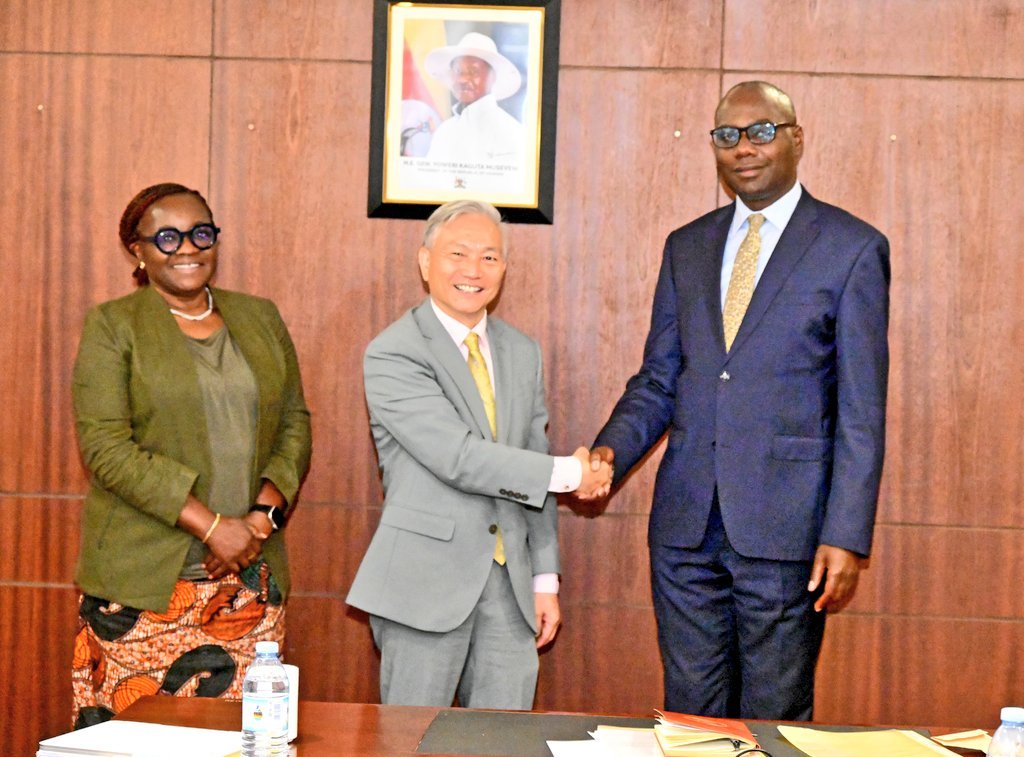
Musasizi made the remarks on Friday during a meeting with the World Bank Division Director for Kenya, Rwanda, Somalia and Uganda, Qimiao Fan, at the Ministry of Finance headquarters in Kampala.
The meeting focused on reviewing key development priorities, addressing implementation bottlenecks and strengthening the long-standing partnership between Uganda and the World Bank.
The discussions come at a time when Uganda’s World Bank-funded portfolio has expanded significantly, reaching USD 4.72 billion, making the institution one of the country’s largest development partners.
However, despite the growing investment, only 32 percent of the funds have been disbursed, raising concerns over delays in delivering critical infrastructure and social development projects.
“We deeply appreciate the World Bank’s continued partnership and commitment to Uganda’s socio-economic transformation,” Musasizi said during the meeting.
He noted that the World Bank has played a pivotal role in financing projects across key sectors including transport, agriculture, energy, education, health, water and sanitation, social protection, governance and institutional development.
According to the minister, these investments have significantly contributed to Uganda’s economic growth while improving the quality of life for millions of Ugandans through expanded infrastructure, better public services and institutional reforms.
Despite the progress, Musasizi expressed concern over the slow pace at which funds are being utilized.
“We have seen our portfolio grow and now stands at USD 4.72 billion,” he said, before lamenting the low disbursement performance rate of 32 percent.
He attributed the poor performance to several challenges affecting both the Government of Uganda and the World Bank, emphasizing that responsibility for improving implementation lies with both parties.
“The Government and the Bank must work together closely to ensure project performance improves drastically,” Musasizi said.
He further stressed that all World Bank-funded interventions should be aligned with Uganda’s ATMS (Accelerated Tenfold Growth Strategy) and other national development enablers to maximize their contribution toward the country’s economic transformation agenda.
The Finance Minister also commended the World Bank for successfully concluding Uganda’s new Country Partnership Framework (CPF), describing it as an important roadmap that will guide cooperation between the government and the development partner over the coming years.
He noted that the framework aligns well with Uganda’s national priorities, including strengthening domestic revenue mobilization, investing in productive infrastructure, promoting value addition and supporting export-led growth.
The Country Partnership Framework is expected to guide future World Bank investments while ensuring development financing is directed toward sectors capable of accelerating economic growth and job creation.
For his part, World Bank Division Director Qimiao Fan congratulated Musasizi on his recent appointment as Uganda’s Finance Minister and expressed confidence in his leadership.
Qimiao said he was encouraged by the minister’s vision for Uganda’s economy and welcomed the government’s ambitious strategy to expand the country’s economy tenfold.
“I am delighted with the Vision of the Minister,” Qimiao said, adding that the new Country Partnership Framework is clearly aligned with Uganda’s tenfold growth strategy.
Addressing concerns over the slow utilization of project funds, the World Bank official pointed to several long-standing implementation challenges that continue to delay project execution.
Among the key obstacles, he cited prolonged procurement processes, delays in land acquisition and the slow compensation of Project Affected Persons (PAPs), issues that have repeatedly delayed the commencement and completion of major infrastructure projects across Uganda.
Qimiao urged the government to prioritize resolving these bottlenecks if it hopes to significantly improve project disbursement rates.
He emphasized that addressing procurement inefficiencies and accelerating compensation processes would enable projects to move faster from approval to implementation, ensuring that committed resources benefit citizens in a timely manner.
The meeting underscored the importance of continued collaboration between Uganda and the World Bank at a time when the country is pursuing ambitious economic transformation goals under its tenfold growth strategy.
With a financing portfolio worth nearly USD 5 billion, the World Bank remains a critical partner in funding roads, energy infrastructure, education programmes, healthcare improvements, agricultural modernization and water projects that are central to Uganda’s development agenda.
However, experts have consistently argued that increasing financing alone is insufficient unless implementation challenges are addressed to ensure projects are completed on schedule and within budget.
The discussions also highlighted the need for stronger coordination between government ministries, agencies and development partners to remove administrative bottlenecks that continue to slow project delivery.
Also attending the meeting was Minister of State for General Duties Cissy Mulondo, alongside World Bank Country Manager Fransisca Ayodeji Akala and other senior officials from both the Government of Uganda and the World Bank.
The engagement is expected to strengthen cooperation between the two sides as they work to improve project implementation, accelerate fund disbursement and deliver greater development impact across Uganda.