
The Government of Uganda has launched a Shs694 billion water and sanitation project expected to provide more than one million people in Wakiso, Mpigi and surrounding areas with a reliable supply of clean drinking water.
The Wakiso West Water and Sanitation Project, being implemented through the National Water and Sewerage Corporation (NWSC), will draw water from Lake Victoria at Bwerenga and supply some of the fastest-growing communities on the western and southern outskirts of Kampala.
The project will serve Kyengera, Nsangi, Kajjansi, Kasanje, Kiringente, Wakiso Town Council and Mpigi Town Council, as well as communities along the Entebbe Road corridor and areas between Entebbe, Masaka and Mityana roads.
The Shs694 billion investment, equivalent to approximately €145 million, is intended to address persistent water shortages in communities where households have increasingly depended on rationed supplies, private water vendors and alternative sources.
NWSC Managing Director Dr Silver Mugisha said the project would significantly improve access to safe drinking water once completed.
“Upon completion, the project is expected to provide over 1 million people with uninterrupted access to safe, reliable drinking water,” Mugisha said.
NWSC Signs Shs47.5 Billion Consultancy Contract
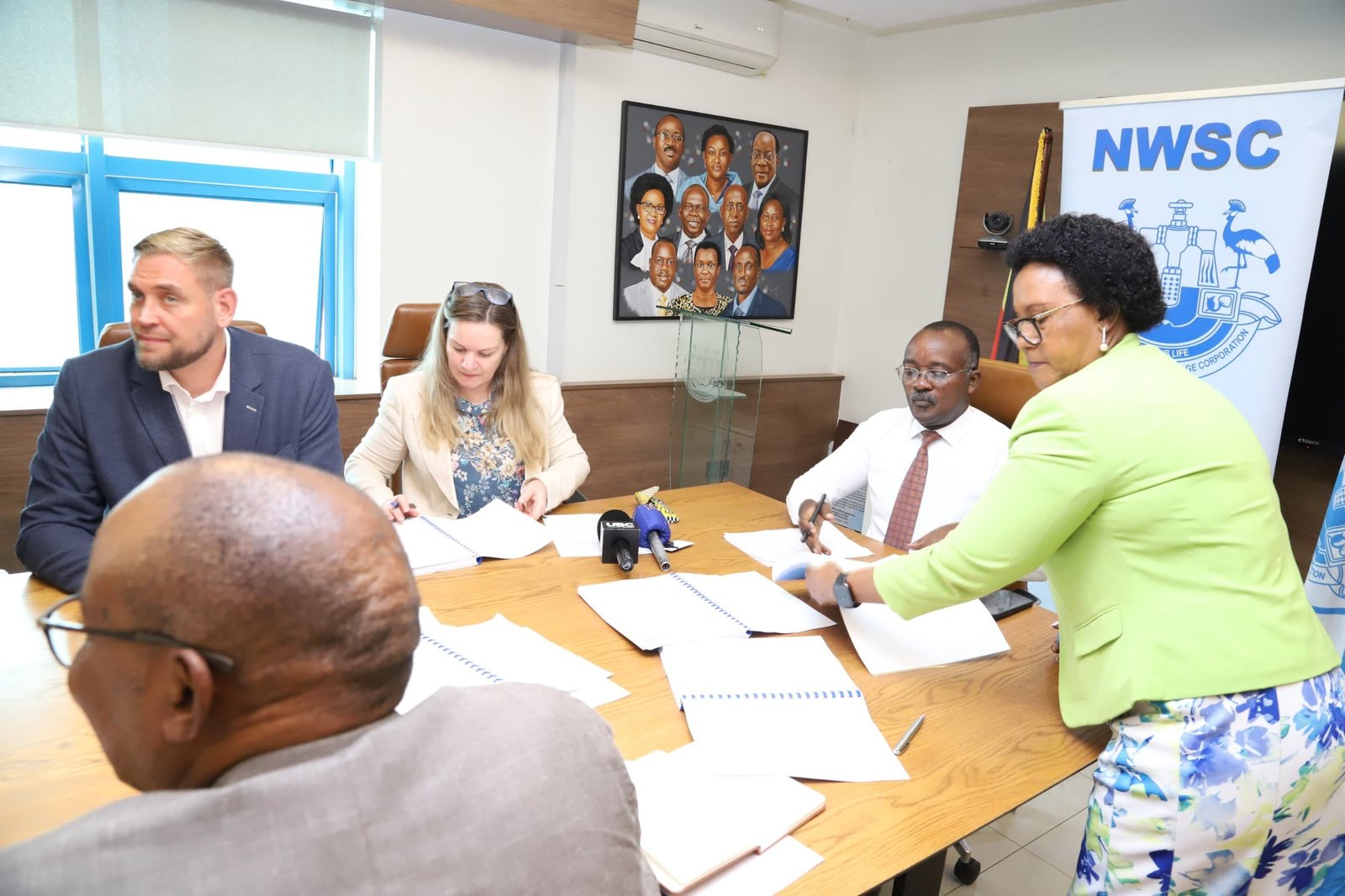
As part of the project’s implementation, NWSC on Tuesday signed a consultancy contract valued at approximately Shs47.5 billion.
The contract, comprising €9.48 million and Shs2.15 billion, excluding taxes, was awarded to a joint venture involving Danish firm NIRAS A/S and German engineering company Fichtner GmbH & Co. KG.
Ugandan firms M&E Associates Ltd and Alliance Consultants Ltd will participate as sub-consultants.
The consultants will undertake the engineering designs, prepare tender documents and supervise construction works.
Their involvement is expected to guide the technical development and implementation of the major water infrastructure project.
Bwerenga Plant to Produce 62.5 Million Litres Daily
At the centre of the project is a new water treatment plant at Bwerenga, which will have the capacity to treat 62.5 million litres of water daily.
Its lake intake infrastructure will be capable of drawing up to 200 million litres per day.
The treated water will be transported through an extensive network comprising 94.2 kilometres of transmission pipelines and 78.5 kilometres of secondary pipelines.
The distribution system will feed five major reservoirs at Kaga, Nsangi, Nanziga, Mpigi and Bukasa, with a combined storage capacity exceeding 15.25 million litres.
Additional pumping stations will be constructed at Buloba, Katende, Maya and Ssekiwunga to facilitate the movement and distribution of water across the service area.
The project will cover approximately 4,300 hectares.
Water Shortages in Kampala’s Western Suburbs
The investment comes amid growing pressure on Kampala’s water supply infrastructure as the metropolitan population continues to expand.
Kampala’s two major water treatment facilities at Ggaba and Katosi are located on the eastern side of the city, meaning water must travel considerable distances through the existing pipeline network to reach western and southern communities.
Rapid urbanisation and population growth have increased demand, placing additional pressure on infrastructure serving areas such as Kyengera, Mutundwe, Lubowa, Buziga and Munyonyo.
Some communities have consequently experienced intermittent water supply, with households in the most affected areas subjected to rationing.
In August, residents of Kyengera told NTV Uganda that they were buying water from wells at between Shs1,000 and Shs2,000 per jerrycan.
The 2024 National Population and Housing Census put the combined population of Kampala and Wakiso at more than 5.2 million, with Wakiso emerging as Uganda’s most populous district.
Mugisha previously acknowledged the growing pressure on the water network, saying demand in the Greater Kampala Metropolitan Service Area was increasing daily and customers needed solutions.
The Bwerenga project is expected to provide additional treatment and distribution capacity, reducing pressure on existing infrastructure.
941 Community Water Points for Informal Settlements
Beyond expanding the main water network, the project includes specific interventions targeting low-income households and residents of informal settlements.
According to NWSC, approximately 160,000 of the expected beneficiaries live in informal settlements, where access to affordable and reliable water remains a major challenge.
The corporation plans to install 941 community water dispensers and yard taps fitted with electronic prepaid meters.
The facilities will be distributed across 19 parishes, including Kimbejja, Katereke, Kisozi/Kitemu, Nsangi, Kasenge, Kikajjo, Bweya, Kitende, Namulanda, Nkungulutale, Kafumu, Kikonkoma, Lwanga, Bumoozi, Kakoola, Kavule, Maziba, Ssisa and Wamala.
Mugisha said the intervention was designed to ensure that underserved communities also benefit from the investment.
“Recognising the importance of inclusive access to essential services, the project will establish 941 community water dispensers in informal settlements,” he said.
“These interventions are intended to make safe water more accessible and affordable, particularly for underserved communities.”
The prepaid water facilities are expected to improve access for households that may not have individual connections to the main distribution network.
Project Includes Faecal Sludge Treatment Plant
The Shs694 billion project will also address sanitation challenges through the construction of a faecal sludge treatment plant along Ssekiwunga Road in Kajjansi.
The facility will have the capacity to handle at least 400,000 litres of faecal sludge daily.
NWSC says the investment will help address indiscriminate disposal of faecal sludge, which poses risks to public health and contaminates surface and groundwater resources.
The corporation said the facility would reduce environmental pollution and minimise health risks associated with inadequate sanitation infrastructure.
The project will also incorporate renewable energy infrastructure, with solar panels expected to generate at least 2,945 kilowatts at selected sites.
The inclusion of solar power is intended to support the project’s energy requirements while promoting more sustainable operations.
With the consultancy contract now signed, the project moves into the design, procurement preparation and construction supervision stages.
Once implemented, the Wakiso West Water and Sanitation Project is expected to significantly expand water supply infrastructure in the Greater Kampala Metropolitan Area, particularly in communities that have struggled to keep pace with the region’s rapid urban growth.