


If irony were a construction material, Uganda would by now have paved highways of it stretching from Kampala to Karamoja—and perhaps roofed every vulnerable household twice over.
Instead, what the country has are 2,000 very real, very tangible iron sheets that somehow took a scenic detour from the dry, hardship-stricken plains of Karamoja to a farm in Mukono, courtesy of a former minister who, it turns out, was just as surprised as anyone else that government property is not meant to be treated like a personal home improvement kit.
On Wednesday, April 8, 2026, the Anti-Corruption Court in Kampala finally did what many had long suspected might take an eternity—or at least several more commissions of inquiry, press statements, and strategic silences—to happen: it convicted former State Minister for Karamoja Affairs, Agnes Nandutu, for dealing with suspect property.
The property in question, of course, being those now-famous iron sheets—2,000 of them—destined originally for some of the most vulnerable communities in Uganda, but which instead found themselves basking in the relative comfort of private use.
It has taken three years to get here. Three years of legal maneuvering, public outrage, selective accountability, and what might generously be described as a national masterclass in how public resources can develop a mind of their own and relocate.
Back on April 19, 2023, when Nandutu first appeared in court, the scandal was still fresh, still hot, still wrapped in the kind of outrage that only comes when citizens realize that even the most basic relief items—iron sheets, for heaven’s sake—are not safe from elite appetite.
Now, with a conviction finally secured, the story has come full circle. Or perhaps not a full circle—more like a loop with several conspicuous exits taken by others who were also implicated but somehow managed to miss the legal bus.
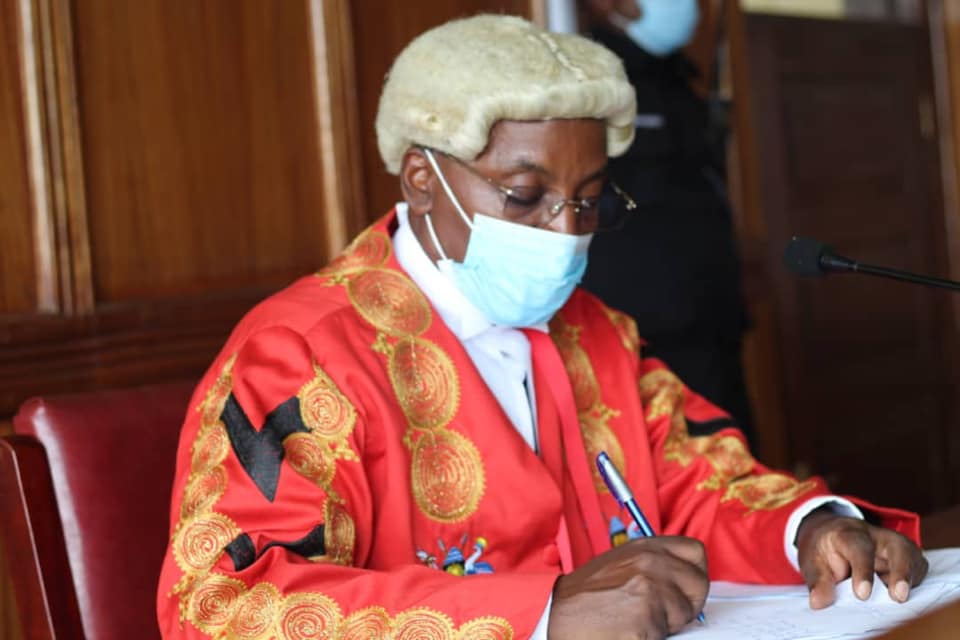
Justice Jane Kajuga, delivering the judgment, made it clear that the court had little patience for creative interpretations of public service.
According to her, the prosecution had done its homework—rare enough in itself to deserve applause—and had proven beyond reasonable doubt that Nandutu received and retained government property that was neither lawfully allocated to her nor plausibly misunderstood as a gift.
“I am satisfied that the prosecution has adduced evidence beyond reasonable doubt that Nandutu received 2,000 iron sheets from OPM stores in Namanve,” the judge ruled, in what might be the most straightforward statement ever made about such a convoluted saga.
Straightforward, of course, unless you consider the broader context: that these iron sheets were part of a much larger consignment—10,000 in total—procured under a government programme aimed at supporting vulnerable communities in Karamoja during the disarmament process.
In simpler terms, these were not decorative items. They were not tokens of appreciation. They were not campaign materials. They were supposed to keep roofs over the heads of people who have, historically, had very little else to rely on.
But somewhere between procurement and distribution, the iron sheets appear to have developed an impressive ability to vanish into thin air—or, more accurately, into the compounds of well-connected individuals.
Court heard that between June and July 2022, Nandutu received her share of the bounty—2,000 iron sheets—from the Office of the Prime Minister stores and transported them to her farm in Mukono District. Because, naturally, when one thinks of Karamoja relief efforts, Mukono farms immediately come to mind.
The defense, for its part, did not dispute that Nandutu had indeed dealt with the iron sheets. That would have been a difficult argument to sustain, given the trail of evidence and the rather inconvenient fact that the sheets were physically found where they should not have been. Instead, the defense leaned on a mixture of explanations that might generously be described as imaginative.
At various points, it was suggested that the iron sheets were intended for northern Uganda. Or perhaps for disaster victims in Bududa, Nandutu’s home district. Or perhaps for some other noble cause that, regrettably, left no paperwork behind.
The court, however, proved stubbornly attached to the idea that claims require evidence.
“There is no evidence that OPM provides iron sheets as relief items to Bududa, and no documents were produced to show that the 2,000 iron sheets were meant for that region,” Justice Kajuga noted, effectively dismantling the argument with the kind of calm precision that tends to frustrate creative defenses.
Even local authorities in Bududa, it turned out, were caught off guard by the sudden appearance of iron sheets supposedly meant for them. According to testimony, they only learned about the sheets after the scandal had already broken out—an unfortunate detail that undermined the narrative of well-intentioned redistribution.
But perhaps the most striking aspect of the judgment was not the confirmation that Nandutu had the iron sheets—that much had been obvious for some time—but the court’s emphasis on what she knew, or at the very least, what she should have known.
Because here’s the thing: being a minister is not just about enjoying the title and the accompanying privileges. It also comes with a rather inconvenient expectation—that one understands how government programmes work.
“As a minister, she was privy to the budgeting processes and aware of the rightful beneficiaries. Any reasonable person in her position would have known,” Justice Kajuga said.
In other words, ignorance was not just implausible—it was, for all practical purposes, impossible.
This is where the sarcasm practically writes itself. Because if a State Minister for Karamoja Affairs cannot distinguish between iron sheets meant for Karamoja and iron sheets meant for, say, her own farm, then one is left wondering what exactly the job entails.
Is there a manual somewhere that explains this? A training session perhaps? Or is it simply assumed that common sense will do the job?
Apparently not.
The court also addressed the broader issue of how the iron sheets were distributed in the first place. Of the 10,000 sheets procured, only 1,000 were used for their intended purpose during the programme’s official launch. The remaining 9,000 were, to put it mildly, “irregularly distributed.”
That is one way to describe it. Another might be “systematically diverted,” or perhaps “enthusiastically appropriated.”
Most of the beneficiaries, the court heard, were top politicians in the ruling party—individuals who, it is safe to assume, were not sleeping under leaking roofs in Karamoja.
And yet, in a twist that surprises absolutely no one who has followed Ugandan politics for more than five minutes, most of these individuals were never prosecuted.
Yes, you read that correctly. While the iron sheets traveled widely, accountability did not.
“I am convinced that the 10,000 iron sheets for Karamoja were received in OPM stores and did not leave until June when the accused received the 2,000 iron sheets,” the judge stated, carefully outlining the timeline of events.
What the judgment does not—and perhaps cannot—fully explain is how a programme designed to support vulnerable communities ended up benefiting those who are, by any reasonable standard, anything but vulnerable.
But then again, perhaps that is the wrong question to ask.
Perhaps the real question is: why is this surprising?
The court also pointed to evidence linking the distribution of the iron sheets to instructions from then Minister for Karamoja Affairs, Mary Goretti Kitutu. However, it was quick to clarify that such instructions did not, in any way, justify the unlawful allocation.
“It is clear that the iron sheets meant for Karamoja affairs could not be distributed to any other region,” the judge noted, stating what should have been obvious from the start.
And yet, here we are.
Nandutu’s defense that she acted in good faith—and that she had been sidelined within the ministry—was dismissed as unsubstantiated. The court appeared particularly unimpressed by the notion that 2,000 iron sheets could be casually received without formal requisition or identified beneficiaries.
“It is shocking how casually the 2,000 iron sheets were received without formal requisition or identified beneficiaries,” Justice Kajuga observed.
Shocking, yes. But also, in a strange way, entirely consistent with the broader pattern of the scandal.
Because if there is one thing the Karamoja iron sheets saga has demonstrated, it is that when it comes to public resources, the line between official duty and personal convenience can become remarkably blurred—especially when oversight is weak and accountability selective.
In the end, the court concluded that Nandutu had reason to believe the iron sheets were acquired through an offence—namely, the diversion of public resources.
“I accordingly convict her of the offence,” the judge ruled.
And just like that, three years of legal proceedings culminated in a single, decisive moment.
Following the conviction, Nandutu’s bail was cancelled, and she was remanded to Luzira Prison pending sentencing scheduled for Friday, April 10.
It is, in many ways, a dramatic fall from grace. From ministerial office to prison remand, from policymaker to convicted offender.
But it is also, depending on how one looks at it, an incomplete story.
Because while Nandutu now faces the consequences of her actions, many others who were implicated in the same scandal have somehow managed to avoid a similar fate.
Take, for instance, State Minister for Finance Amos Lugoloobi, who was arrested and indicted in June 2023 on two counts of dealing with suspect property after allegedly diverting 700 iron sheets.
Those charges were later withdrawn by the Director of Public Prosecutions, leaving Nandutu to face court alone.
Alone, that is, except for the lingering question of why accountability appears to be so unevenly distributed.
In 2023, then DPP Jane Frances Abodo declined to sanction files against several other top government officials, citing lack of sufficient evidence.
And perhaps that is true. Perhaps the evidence simply was not there.
Or perhaps, as many Ugandans suspect, the standards of evidence are more flexible than the iron sheets themselves.
Either way, the result is the same: a scandal that implicated many has ultimately resulted in the conviction of a few.
Nandutu’s conviction comes at a time when public concern over corruption remains high. International corruption watchdogs continue to rank Uganda poorly in its efforts to combat the vice, and stories like this do little to inspire confidence.
Because if even iron sheets—basic, visible, countable items—can be diverted on such a scale, what does that say about resources that are less tangible, less traceable?
It raises uncomfortable questions.
Questions about systems. About accountability. About whether justice, when it comes, is comprehensive or merely symbolic.
For now, however, the focus remains on Nandutu.
On her conviction. On her impending sentencing. On what message, if any, this case will send.
Will it serve as a warning to others?
Will it mark a turning point in the fight against corruption?
Or will it simply be remembered as yet another chapter in a long-running story—one in which public resources continue to find their way into private hands, and accountability continues to arrive late, selectively, and with just enough force to maintain appearances?
Time, as always, will tell.
In the meantime, somewhere in Karamoja, there are still communities that were meant to receive those iron sheets.
Communities that are, presumably, still waiting.
And somewhere in Mukono, there is a farm that, for a brief moment in time, became an unintended symbol of everything that can go wrong when public trust is treated as just another resource to be managed—or mismanaged—at will.