

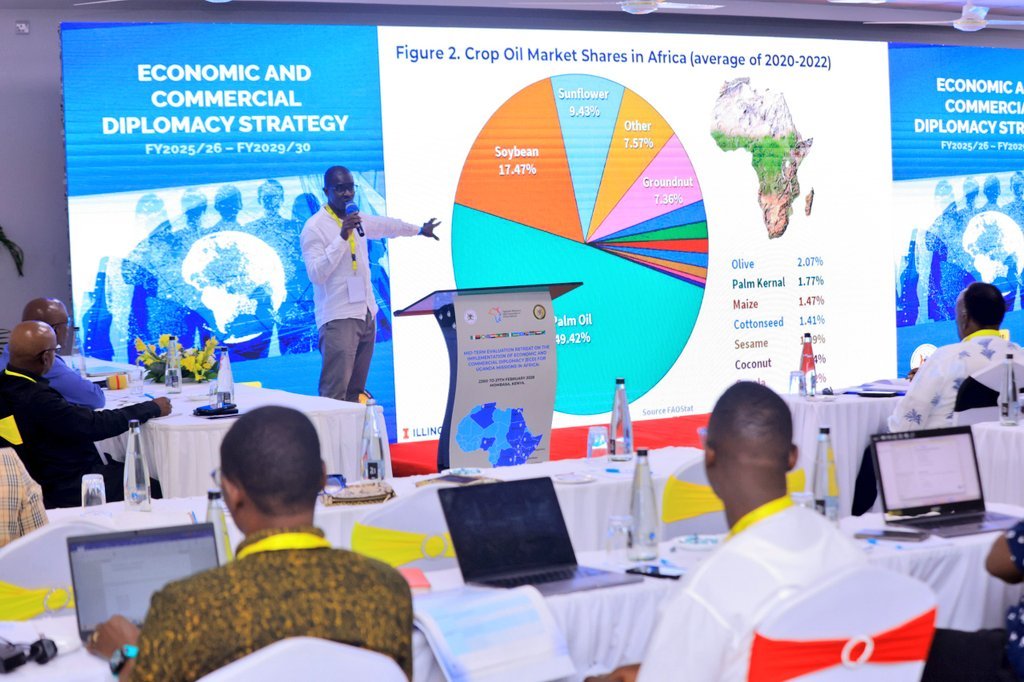
Uganda has intensified efforts to position its homegrown brands as continental powerhouses following a high-level Economic and Commercial Diplomacy (ECD) Strategy mid-year review convened by the Ministry of Finance, Planning and Economic Development in Mombasa.
The session, chaired by Commissioner for Economic Development Policy and Research Joseph Enyimu, focused on shaping the country’s Economic and Commercial Diplomacy priorities for the Financial Year 2026/27 under the theme: “ECD in Africa – Positioning Uganda’s Pan-African Brands as Continental Leaders.”
Addressing officials and stakeholders, Enyimu underscored the urgency for Uganda to strategically tap into Africa’s rapidly expanding urban markets. He noted that cities across the continent are growing at an unprecedented rate, driving up demand for proteins, grains and edible oils.
“Africa’s cities are growing fast, and so is the demand for food commodities. Uganda must position itself as a market leader by scaling up production, attracting investment, building competitive Pan-African brands and developing brand-specific dominance strategies,” Enyimu said.
He pointed out that despite Africa’s vast arable land, the continent continues to grapple with persistent food deficits — a paradox that presents both a challenge and a significant opportunity for Uganda.
According to Enyimu, Uganda can leverage this gap to strengthen its footprint in key sectors including food security and oil markets, dairy production, pharmaceuticals, local manufacturing, and strategic infrastructure development. He emphasized that mobilizing the private sector will be critical in translating policy direction into tangible economic gains.
The Commissioner stressed that Uganda’s Economic and Commercial Diplomacy framework must move beyond rhetoric and focus on execution. “Growth will not happen by default. It requires intentional and focused execution,” he said, calling for coordinated efforts between government agencies, trade missions and private enterprises.
The ECD Strategy is part of Uganda’s broader push to expand exports, diversify markets and promote value addition under regional and continental trade frameworks such as the African Continental Free Trade Area (AfCFTA). By positioning its brands strategically within Africa, Uganda aims to capture a larger share of intra-African trade and reduce overreliance on traditional export markets outside the continent.
Officials at the meeting also reviewed progress made in implementing ongoing ECD initiatives and assessed emerging opportunities in priority markets across East, West and Southern Africa. Particular attention was given to strengthening Uganda’s brand identity in agro-processing, edible oils, dairy, pharmaceuticals and light manufacturing.
The Mombasa session comes at a time when African governments are increasingly focusing on food sovereignty, industrialization and regional value chains as pillars for sustainable growth. For Uganda, the message from the mid-year review was clear: the country must act decisively to convert its agricultural potential and entrepreneurial capacity into continental leadership.
With Africa’s population projected to continue rising and urban consumption patterns shifting toward processed and higher-value products, Uganda’s strategy hinges on scaling productivity, improving standards and branding, and fostering investment partnerships.
As preparations for FY 2026/27 gather momentum, the Ministry signaled that measurable targets, sector-specific strategies and stronger commercial diplomacy will define the next phase of Uganda’s economic engagement on the continent.