


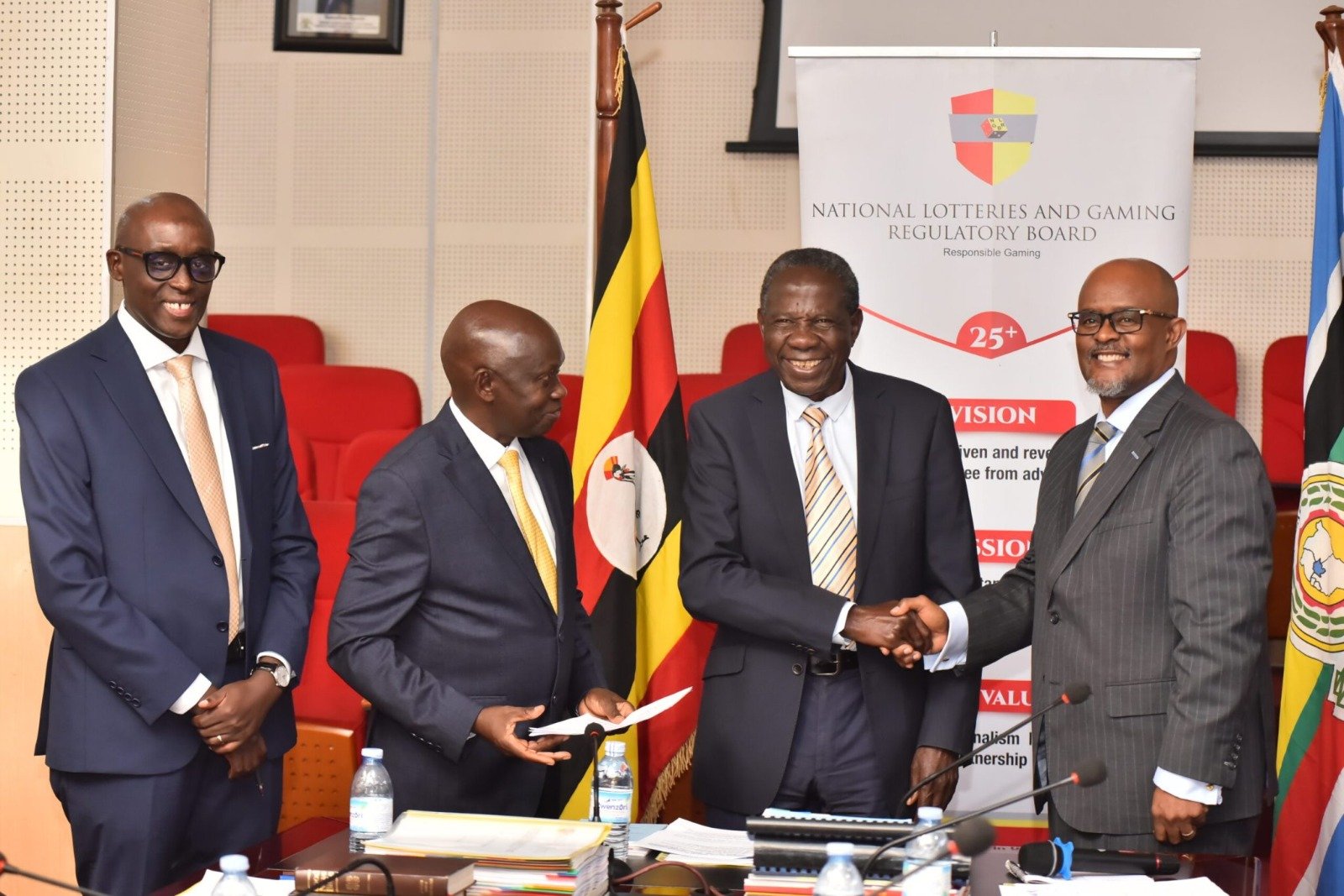
Ten years after its creation, the National Lotteries and Gaming Regulatory Board has transformed from a small regulator with minimal returns into one of Uganda’s leading sources of non-tax revenue, with gaming stakes projected to reach Shs14.1 trillion.
When the sector was first formalised, its projected contribution to the economy was only Shs50 billion. A decade later, the trajectory has shifted dramatically.
While appearing before Parliament’s Committee on Finance, Planning and Economic Development, Acting Executive Director Bernard Winyi outlined the Board’s rapid revenue expansion, attributing it to reforms in licensing, compliance enforcement and digital monitoring.
According to Winyi, non-tax revenue collections have grown eightfold due to improved licensing frameworks, revised fee structures and stronger compliance systems. Collections rose from Shs1.14 billion in FY2019/2020 to Shs8.79 billion in FY2024/2025. Since the Board’s establishment in FY2015/2016, annual revenue has surged from Shs17.4 billion to Shs323 billion in FY2024/2025. By the end of FY2025/2026, collections are projected at Shs391 billion, with further growth expected.
A major catalyst for this expansion has been the National Central Electronic Monitoring System, introduced after Parliament increased the regulator’s funding in FY2022/2023. The platform replaced operator self-reporting with real-time digital tracking of gaming activity.
Before the system’s rollout, operators declared stakes themselves. With digital monitoring in place, recorded stakes rose to Shs4.3 trillion in FY2023/2024 and Shs8.3 trillion in FY2024/2025. Projections indicate stakes will reach Shs14.1 trillion in FY2025/2026, significantly improving revenue visibility and tax assessment.
Lawmakers commended the progress. Paul Omara praised the Board’s management and pledged support for increased funding, noting its growth mirrors that of the Uganda Revenue Authority.
However, Parliament also raised concerns about persistent illegal gaming machines nationwide. Dicksons Kateshumbwa questioned how illicit imports continue despite seizures of over 1,400 devices.
Winyi acknowledged enforcement challenges, explaining that many illegal machines enter the country disguised as tax-exempt computer components such as motherboards before being assembled locally. He said the regulator is now working with URA customs to improve detection at entry points.
Looking ahead, the Board’s FY2026/2027 budget targets Shs450 billion in revenue—about 15 percent higher than the projected Shs391 billion for FY2025/2026. The strategy prioritises stronger enforcement against illegal gambling, tighter compliance and full optimisation of the electronic monitoring system.
Amos Lugoloobi, State Minister for Finance and Planning, urged Parliament to maintain investment in the sector, arguing that stronger regulation and enforcement could unlock even greater returns.
A decade on, the sector’s figures reflect more than rising gambling activity. They underscore how regulatory reform, technology-driven oversight and sustained parliamentary support have converted a once modest industry into a significant pillar of Uganda’s domestic revenue mobilisation.